"The women of Bikini Kill let guitarist Billy Karren be in their feminist punk band, but only if he's willing to just "do some shit." Being a feminist dude is like that. We may ask you to "do some shit" for the band, but you don't get to be Kathleen Hannah."--@heatherurehere


Showing posts with label bell hooks. Show all posts

Wednesday, September 11, 2013

Men and Feminism: Kind of Complicated

Isabelle Allonso interviewed John Stoltenberg for her blog, and Feminist Current was kind enough to publish an english translation.  It's an illuminating interview that is definitely a worthwhile read for feminist allies. When asked about men's place in relationship to feminist work, Stoltenberg said this: 
First of all I don’t think any man of conscience—whether self-identified as pro-feminist or not—can or should presume to speak in women’s place or “decide what feminism should be about.” That’s just a baseline principle. Many women have justifiable grievances about individual men who have disregarded it. Those “me too” men ought to know better, and they should not require scolding and hand-holding from women to figure it out, because exemplary life lessons abound: Individuals from the dominant class in other struggles have found countless meaningful ways to be of use while analogously abiding by that principle—for example, whites in the black civil-rights movement in the US, sons and daughters born to wealth in the movement for economic justice, non-Jews in the movements against antisemitism. Such sincerely committed allies always recognize and acknowledge the privilege that stems from their membership in the dominant class. And often such allies have found that their usefulness lies in deconstructing, disrupting, interrupting, exposing, protesting, and defying such systems of oppression from the inside. Same holds for any man of conscience who wishes to be of use on behalf of feminist revolution. It’s not complicated.--john-stoltenberg 
As with much that Stoltenberg has written, I find myself agreeing with the central points here, but disagreeing in important ways about how the execution of this stuff works; often my disagreements boil down to "but it's more complicated than that," something that one can almost always say and be correct about; still given that in this case Stoltenberg says "It's not complicated," I feel like I should chime in, because I think it can be complicated in important ways that we should acknowledge.

I think presuming to speak for women is something that allies constantly have to guard against doing--male privilege runs deep. But when Stoltenberg says pro-feminist men shouldn't decide what feminism should be about, we have to be careful to not equivocate: I agree that pro-feminist men shouldn't simply put out there what they think feminism should be about as if they are some sort of final arbiters of the definition of feminism.  However, pro-feminist men not only need to decide what feminism(s) make sense (to them), an argument can be made that they need to voice their views on this decision, perhaps even in the face of disagreeing with other feminists, regardless of the genders of those feminists.

Feminism isn't a monolith.  When folks of any gender first run into feminist concepts, we all begin to learn the conceptual frameworks involved.  Some find these concepts in academia, some through communities they are involved in, some even from pop culture.  To be clear: We all encounter what sexism is far earlier than that--but the conceptual frameworks around feminism come later.  Indeed, that is part of what feels so empowering for many of us--we finally have different ways of talking about (and hopefully changing) how fucked up sexism (and homophobia, and class issues, etc.) are, when we discover feminist frameworks, or lenses. Thing is, depending upon our own experiences, and upon how we first start understanding how we might work against sexism and the like, we almost immediately have to choose which feminism(s) seem to make sense to us. People of all genders do this, though of course they do it from different perspectives because of their gender (and for other reasons).  

So-called "radfem" folks, in the opinion of many feminists, are wrong about trans folks in important ways. "Mainstream" feminists are wrong about what feminism is about, according to many "radfems". Pro-sex feminists are wrong about sex work, according to folks like Gail dines (as well as the folks at Feminist Current, and Stoltenberg himself!) Womanists and other women of color call out feminists for racism underlying much of modern feminism. And these are just a few of the major disputes--there are myriad disputes around all sorts of issues. Where female feminists disagree, pro-feminist men may/must also disagree with at least some female feminists!

Now, because of various complexities, I also don't think that pro-feminist men need to be chiming in on every issue in every feminist space; even in spaces that welcome men explicitly (and there are many), I think Stoltenberg's general ideas here are true: There are so many ways that men can be of use to "feminist movement" (to use bell hooks' phrasing), and given male privilege, we ought to do much more listening than talking, more assisting and less leading. But I don't think it's "just that simple".  Men also may need to support the feminism(s) that we think make the most sense--and to do that we may need to also engage other men, women and folks of other genders in conversation about what we think makes the most sense.  That may mean (for me) mindfully talking about why I think some anti-pornography stances are wrong, or why I find the racism underlying much of modern feminism problematic. It might mean calling out other men on their sexism. It also means helping to create some feminist spaces that include men consciously and consistently in the movement--all the while acknowledging that some spaces will not and should not include men. 

And much of this work is complicated.  I think there is some harm that can come from the "it's just that simple" ways of thinking about men and feminism, because it can encourage folks to tend to ignore that feminism itself isn't a monolith, and to ignore that men, too, must understand, engage within and choose what feminism(s) make sense.  It's a good rule of thumb to defer to women in general as regards what feminism is, but because not all women agree on what feminism is, we're going to sometimes disagree with some female feminists--this may be read as "trying to define feminism," but if we back up what we're saying by acknowledging female feminists who agree with us, this is something valuable to do, if sometimes complexities abound. 

In that spirit, here's bell hooks:
 “A male who has divested of male privilege, who has embraced feminist politics, is a worthy comrade in struggle, in no way a threat to feminism, whereas a female who remains wedded to sexist thinking and behavior infiltrating feminist movement is a dangerous threat.”—  bell hooks, Feminism Is For Everybody.


Monday, August 19, 2013

bell hooks Monday: NOMAS and Ditching the Dominator Model

Been thinking a lot about whether men can get together with each other to work on shifting masculinities without falling so easily back into traditional masculinity and the misogyny that comes with it, partly because of the fucked up silencing that happened recently from NOMAS (details at Shakesville).

I'm starting to think that men, even really well-meaning men, should always work with women (and folks of all genders) when trying to transform traditional masculinities, or do any feminist work. (I recognize that this blog is guilty of that, and am thinking that through too.)  And yet that brings in other problems, of course: Men already ask women to do so much work in the world, and now we want/need to ask (some of) them to help us change? 


Not sure yet what to do, but it all makes me think of bell hooks infinitely deep contributions to men and feminism(s):
Before the realities of men can be transformed, the dominator model has to be eliminated as the underlying ideology on which we base our culture. We already see that within patriarchal culture men can be more emotional, they can parent, they can break with sexist roles, but as long as the underlying principles are in place, men can never be truly free. At any moment this underlying patriarchal ethos can overshadow behaviors that run counter to it. We have already seen that many men changed their thinking for a time when feminist movement was a powerful force for social change, but then when the patriarchal thinking that undergirds our society did not change, as the energy of the movement began to wane, the old order began to reestablish itself. Sexist thought and action that had been harshly critiqued during the height of feminist movement have once again become more acceptable. Clearly, ending patriarchy is necessary for men to have collective liberation. It is the only resolution to the masculinity crisis that most men are experiencing.--bell hooks, The Will to Change
The dominator model is so obvious in some of the exchanges between some folks at NOMAS and the women they're currently trying to gaslight--I also know that lots of men are working on ditching domination, and that (I think) they need feminism to do it.  

Monday, July 22, 2013

bell hooks Monday: On Feminist Masculinity

http://kfffunk.tumblr.com/post/1087141310/portrait-of-bell-hooks-i-adore-her-work-and-i
Wonderful drawing by k funk. Please go buy stuff from them. 
"As interest in feminist thinking and practice has waned, there has been even less focus on the plight of men than in the heyday of feminist movement. This lack of interest does not change the fact that only a feminist vision that embraces feminist masculinity, that loves boys and men and demands on their behalf every right that we desire for girls and women, can renew men in our society. Feminist thinking teaches us all, males especially, how to love justice and freedom in ways that foster and affirm life. Clearly we need new strategies, new theories, guides that will show us how to create a world where feminist masculinity thrives."--bell hooks, The Will to Change: Men, Masculinity and Love
 Yet another passage that demonstrates why bell hooks is a favorite writer of many a feminist man!  (I would also add that "feminist masculinity" isn't something that only men can benefit from, but people of various genders who think that traditional masculinity is long overdue for some seismic conceptual shifts.) 

I think it is interesting to re-read The Will to Change, a book that is only 8 or 9 years old, and to see how things have changed as regards men and feminism (and also, of course, how they haven't).  Certainly online feminism seems to have upped the ante as regards including men and addressing issues with traditional masculinity.  An article from 2012 on Feministing even addresses the issue that hooks is talking about directly.  Shira Tarrant's book, Men Speak Out: Views on Gender, Sex and Power is now in its second printing (full disclosure--I have an article in the 2nd edition).  I also see a lot of change coming online in the twitterverse--there are myriad feminist and pro-feminist men on twitter who are doing the day-to-day work of online feminism.  And IRL feminist men exist in some of what one might think are the oddest of places.  For instance, I had the good fortune to attend the "allies track" of the Ada Initiative's Ada Camp not too long ago, and met a bunch of feminist and pro-feminist men (and other folks!) who work in open source technology, and are vehemently interested in getting more women to work in open source software fields.  

All of which is not to say that hooks' point doesn't still hit home:  One of the reasons I'm still (occasionally!) writing on this blog is because there need to be various places where men and feminism get discussed, in part so that men don't "take over" feminist spaces that women create, but also simply because the more the merrier (and the more work we'll get done).


Monday, July 15, 2013

bell hooks Monday: Feminism Defined by Patriarchy

As all advocates of feminist politics know most people do not understand sexism or if they do they think it is not a problem. Masses of people think that feminism is always and only about women seeking to be equal to men. And a huge majority of these folks think feminism is anti-male. Their misunderstanding of feminist politics reflects the reality that most folks learn about feminism from patriarchal mass media.
—  bell hooks
 Yet another reason why bell hooks is the go-to feminist for many feminist men.

Monday, July 01, 2013

bell hooks Monday: From Personal Struggles to Systemic Change

From The Will to Change: Men, Masculinity and Love:

"Even though not all men are misogynists, feminist thinkers were accurate when we stated that patriarchy in its most basic, unmediated form promotes fear and hatred of females. A man who is unabashedly and unequivocally committed to patriarchal masculinity will both fear and hate all that the culture deems feminine and womanly. However, most men have not consciously chosen patriarchy as the ideology they want to govern their lives, their beliefs, and actions. Patriarchal culture is the system they were born within and socialized to accept, yet in all areas of their lives most men have rebelled in small ways against the patriarchy, have resisted absolute allegiance to patriarchal thinking and practice. Most men have clearly been willing to resist patriarchy when it interferes with individual desire, but they have not been willing to embrace feminism as a movement that would challenge, change, and ultimately end patriarchy".--bell hooks
Some of what hooks says is here exactly why I think showing men how patriarchy hurts men can be such a powerful tool, but can also be a bit of a trap if you don't follow through.  Show men how traditional masculinity creates men who can't show feelings (other than anger), and some men get that. But if you don't continue to show/see that this fact also harms women, and then on to how women are harmed in general by patriarchy, then you end up with a Men's Rights Activist instead of another feminist. 

And it's a tough move to make--for all of us who have some kind of privilege, it can be a struggle to continue to recognize it, and divesting oneself of it even more of a struggle. (Which is not to compare it to the struggles of folks who are oppressed.)

In some meditation traditions, compassion for others begins with compassion for self; the way it spreads to compassion for others is (in part) by recognizing our interdependent relationships with others.  In the case of the harm of patriarchy, I can, at times, have compassion for men doing harm through patriarchy by myself recognizing how I have been harmed by patriarchy, but then by also acknowledging how we all have been harmed by it--even the men doing the damage right now. It's not a simple thing, of course, and part of the idea is that it's a process that may go on for a lifetime. 

I'm playing with ideas here, and may be way off base, but I suspect that one way of getting more men to understand and embrace feminism has to do with having compassion for the ways that men are harmed by patriarchy--even though this harm may pale in comparison to the harm that women continue to suffer (most often at the hands of men).  I don't claim this is what feminism is all about or anything--but I do think that we men who embrace feminisms need to have compassion for ourselves and for other men, even before those men have begun to understand the harm they are doing. In this way, maybe we can more easily move from what hooks notes is "individual" stuff to actually changing the status quo.   

Monday, July 14, 2008

bell audio

I used to have a weekly series on bell hooks that has (as much else here) fallen by the wayside. But if anybody who loves hooks is still around these parts, you can listen to some of her speeches and Q&A's online. Thanks to Lisa at Black Women, Blow the Trumpet! for the link.

Monday, January 14, 2008

bell hooks Monday: God and Love and All That Good Stuff

Since I haven't responded yet in detail regarding a bunch of comments from my post Can God Be a Feminist?, I thought I would at least offer up a different point of view (than my own) from one of my favorite feminists on god and worship. For bell hooks, what is central to the necessity of a spiritual life is the need to keep our focus on love. It's interesting to note that she moved from being a Christian, to becoming interested in Buddhism and Islamic mysticism, to just keeping in mind that love is where we often find truth.

From Wounds of Passion:
"When I come to college, it does not take me long to realize that the really hip people do not believe in god, that no one talks about religion expect the boring born against. My relationship to god is the most private union. I learn not to speak of it. Although in classes it is always I who can name a scriptural reference. I konw the bible and am not ashamed of this knowing. In fact, it surprises me that everyone in my classes is so ignorant, mostly though they brag about being atheist. That's what is really cool--to not believe in the existence of god. I believe."(pp 152)


I had a moderately different experience in college. I did meet some self-professed atheists in college, but mostly I meet people who claim agnosticism, or a generalized 'spirituality' not unlike what hooks tells us she ends up with. Of course, the atheists I did run across there (some of whom became friends!) were relatively vocal in their atheism not unlike the people hooks seems to be talking about. Hooks, for her part, moves along from her Christianity to look around for other paths:

"Mack finds my devotion to religion strange. I have moved away from the conventional church but I have kept in me the love of the inner life, the need to be one with the divine. I search for the meaning of religious life everywhere. I study Buddhism and Islamic mysticism. In town there is a Sufi meeting. I go there to dance in the circle of love. And that I am learning about the mystical dimensions of religious faith takes me back to the heart, to loving. To be with god is to love. It is required and understood that a man be found faithful. The ethics of being that govern my life are grounded in spiritual life.(pp152-153)"


Who can argue with love, or paying attention to one's inner life? I find it interesting that hooks doesn't seem to explicitly talk about the misogynist aspects of various religions--though I haven't read everything she has written. She does, however, express various ways in which religion has left her wanting--the white Buddhists who say race doesn't matter because we all choose our race, those who try to force their beliefs on others, the difficulties of letting go of the things in this world in order to be more spiritual. In the end, she likes the seeking--seeking seems to be her religion:
"I contemplate my work. I pray for divine guidance. It comes between me and Mack that I am turning from poetry to writing critical essays, on subjects that are more political. He feels I am abandoning the aesthetics of the artists life for the mundane realm of social theory. I am trying to invent a world that can sustain me as a writer, as a woman dedicated to the life of the mind. I want to remain a seeker on the path."(pp160)

I sometimes feel this way about feminism itself, actually. The infighting just kills me sometimes. And, the need for the infighting--there are real problems that need to be addressed--kills me too. When I start feeling like abandoning feminism for, say, humanism or some such, one thing that helps me is to understand the ways in which my relationship to feminism has developed, and the ways in which feminism itself has changed and grown, is to look at it in a similar way to the way that hooks is looking at religion. Seeking a better and better feminism seems to be the way to go--still seeking, even while unhappy with the current path. (Of course, I feel this way about humanism, and anti-racism, and lots of other ways of framing the world.)

Monday, January 07, 2008

bell hooks Monday: Men Who Change

Sorry, only enough time for some insightful words from bell herself this morning. Back to more regular posting soon.

From The Will to Change:
"It is not easy for males, young or old, to reject the codes of patriarchal masculinity. Men who choose against violence ar esimultaneously choosing against patriarchy, wherther they can articulate that choice or not." (pp73)
"Ultimately, the men who choose agaisnt violence, against death, do so because they want to live fully and well, because they want to know love. These men who are true heroes, the men whose lives we need to know about, honor and remember." (pp74)

Monday, December 03, 2007

bell hooks Monday: Resources

Moving away from the regular quote-comment format on bell hooks this week (mostly because my weekend was busier than I had thought it would be!), I'd like to point out two interesting resources regarding bell hooks. Well, one is a resource, and the other is a sort of meta-resource.

First of all, those of us on the left coast can sigh a deep sigh because it looks like hooks isn't coming to speak here anytime soon, but we can be happy because we have a place to check in to see when she will be coming. Check out South End Press' schedule for hooks. (And while you're there, browse their books, because they're got mountains of good stuff.

And then, for all things hooksian (I just made that up, I think), go check out this page of bell hooks resources, provided by the Critical Thinkers Resources pages. In addition to links to articles by hooks, and an expansive bibliography of her work, there are links to lots of sites where you can find lots of people discussing her work, more formally or less formally.

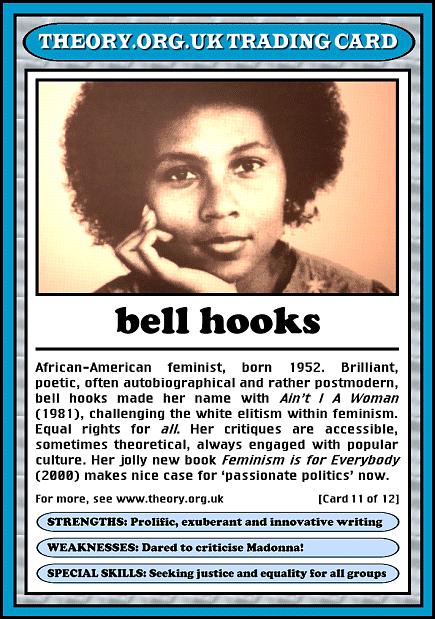
Side note: The picture comes from a funny and interesting site: theorycards.org.uk, which created these online trading cards for theorists of various flavors back in 1999.

Monday, November 26, 2007

bell hooks Monday: Race, Class and Feminism

I am always fascinated when I discover yet another way that feminist concerns intersect with concerns of racism and of class. Continuing our look at Teaching to Transgress, we find hooks giving us some of her students' insights around some of the difficulties with being a black feminist, including some of the difficulties specific to being a black man who is also a feminist:
"Throughout the semester, there was more laughter in our discussions--as well as more concern about negative fall-out exploring feminist concerns--than in any feminist course I have taught. There were also ongoing attempts to relate material to the concrete realities they face as young black women. All the students were heterosexual and particularly concerned about the possibility that choosing to support feminist politics would alter their relationship with black men. They were concerned about the ways feminism might change how they relate to fathers, lovers, friends. Most everyone agreed that the men they knew were grappling with feminist issues were either gay or involved with women who were 'pushing them.' Brett, a close partner of one of the women, was taking another class with me. Since he was named by black women in the group as one of the black males who was concerned about gender issues, I talked with him specifically about feminism. He responded by calling attention to the reasons it is difficult for black men to deal with sexism, the primary one being that they are accustomed to thinking of themselves in terms of racism, being exploited and oppressed. Speaking of his efforts to develop feminist awareness, he stressed limitations: "I've tried to understand but then I'm a man. Sometimes I don't understand and it hurts, 'cause I think I'm the epitome of everything that's oppressed." Since it is difficult for many black men to give voice to the ways they are hurt and wounded by racism, it is also understandable that it is more difficult for them to 'own up to' sexism, to be accountable."

Some similar blinders are in place, I think, as regards some of my peers, who aren't burdened by racism the way hooks' student is, but who are burdened by class issues--once one begins to understand issues of class, and one's own position within those issues, it's sometimes hard to see things through a race-theory lens, or through a feminist-theory lens. My intuition (and it's just an intuition) is that this is one of the reasons that there are often conflicts within, say, liberal politics, between men in power and those of us with feminist interests at the forefront of our goals. (I wonder how much of The Pie Fight Incident over at DailyKos is to blame for this tendency, for instance.)

The lesson isn't that one frame of reference is better than the others, but that movements need to understand intersectionality. Kos may think that ignoring feminist concerns won't matter to his cause(s) in the long run, but I think that's doubtful, given that class issues, feminism and race issues (among others) are inextricably intertwined.

Bonus Poetry on Intersectionality: Stacyann Chin

Monday, November 19, 2007

bell hooks Monday: Teaching, Learning and Safe Spaces

From Teaching to Transgress:
"The unwillingness to approach teaching from a standpoint that includes awareness of race, sex, and class is often rooted in the fear that classrooms will be uncontrollable, that emotions and passions will not be contained. To some extent, we all know that whenever we address in the classroom subjects that students are passionate about there is always a possibility of confrontation, forceful expression of ideas, or even conflict. In much of my writing about pedagogy, particularly in classroom settings with great diversity, I have talked about the need to examine critically the way we as teachers conceptualize what the space for learning should be liked. Many professors have conveyed to me their feeling that the classroom should be a "safe" place; that usually translates to mean that the professor lectures to a group of quiet students who respond only when they are called on. The experience of professors who educate for critical consciousness indicates that many students, especially students of color, may not feel at all "safe" in what appears to be a neutral setting. It is the absence of a feeling of safety that often promotes prolonged silence or lack of student engagement." (pp 39, Teaching to Transgress).
All through grade school, high school and college (at least while I was an undergrad), I loved the sort of 'safe' classrooms that hooks describes above. I loved lectures, I loved answering questions when called upon, and I would get frustrated when students would interrupt that by asking questions out of turn, or bringing up information I thought tangential to the conversation (and pretty much, anything the teacher thought was tangential, I thought was tangential). I tended to not like group work for various reasons, most of which revolved around the sort of psuedo-safety ideas hooks is talking about.

In college, my major was philosophy, and despite the preponderance of individualistic, opinionated people in that discipline, most classrooms were still 'safe' in the way hooks describes. From time to time, somebody would point out the lack of diversity in the discipline, but generally, arguments of that sort were seen as ignoring the 'universal' knowledge that philosophy often purported to reveal--"Yeah, yeah, yeah, women philosophers aren't talked about much, but that doesn't matter because 'critical thinking' is genderless," was the basic line of thought, which ignores the need to 'think critically' about, say, the fact that Socrates (and/or Plato, depending on your viewpoint) thought that women were not only inferior to men, but also sprung into being as former men who were cowards.

When people brought up such subjects, they were often quickly shut down. Of course, there are volumes to be said about the complexities of teaching and learning--'safety' is just one of many goals, for instance. But I think that hooks is right to point out that 'safety' isn't obviously safe for everybody, and is often masking something more like 'safe-for-some' through the shroud of 'normal'.

And this doesn't only apply to the classroom, of course. In fact, one runs into problems of deciding whether or not to rock the boat, which will be seen by some as violating the safety of others, on almost a daily basis. And it's often a fine line to walk, because one does want to limit the parameters of discussion to some degree--no forum is completely "open", and for good reasons. So it's a constant sort of decision-making process, where one is always having to choose in order to create a space where ideas can flourish (and compete?)--allowing in as many new ideas as possible without letting a few people (or ideas) distract from the overall conversation. Anybody who has taught in a classroom or tried to moderate blog comments knows that these decisions aren't always easy, but that they are pretty much constant.

Still, I like to err on the side of not promoting so much 'safety', a good deal of the time, both in classrooms I might find myself in and in conversations with people in general, while in a place like this blog, I find myself policing what I see as not apropos views (anti-feminist talking points, racism, and the like) more than I would in other public forums, partly because of the lack of social pressure to be kind to others, and respectful, on The Interweb. Luckily, there is not just one idea space which can be safe or unsafe--there are lots of communities where various opinions can be explored.

Monday, November 12, 2007

bell hooks Monday: Little Conversations Go a Long Way

As I've mentioned before, I came to feminist theory through philosophy, and one of the first explicitly feminist texts I read was bell hooks' Teaching to Transgress: Education as the Practice of Freedom. We read the book for a class called Democracy and Eduction, and while a lot of the books had a lasting effect on me, Teaching to Transgress is the one I still go back to from time to time. And, like all of hooks' books (at least the one's I've read), it's not just about it's central subject matter--she infuses her ideas about race, class and gender (among other things) throughout the work, even though it is technically a work on pedagogy.

One simple thing that I've taken away from the book is that teaching and learning happen every day, and that, given an approach that opens the minds of others, people tend to be very interested in talking about feminist issues. hooks describes this phenomena early on in Teaching to Transgress:
"I am grateful that I can stand here and testify that if we hold fast to our beliefs that feminist thinking must be shared with everyone, whether through talking or writing, and create theory with this agenda in mind we can advance feminist movement that folks will long--yes, yearn--to be a part of. I share feminist thinking and practice wherever I am. When asked to talk in university settings, I search out other setting or respond to those who search me out so that I can give the riches of feminist thinking to anyone. Sometimes setting emerge spontaneously. At a black-owned restaurant in the South, for instance, I sat for hours with a diverse group of black women and men from various class backgrounds discussing issues of race, gender and class. Some of us were college-educated, others were not. We had a heated discussion of abortion, discussing whether black women should have the right to choose."--pp 72-73, Teaching to Transgress.
The more one gets exposed to the ideas within feminism, the more one sees that lessons to be learned (and taught) are everywhere, and that one has a sort of embarrassment of riches as far as being able to show, for example, that pop culture tends to encourage misogyny. And one has a chance to talk with people about this stuff almost every day.

The other day I was on a conference call with a few of the people I work with often, two men around my age, when one started teasing the other about having worn a pink shirt. I eventually asked the person doing the teasing what colors he though men should wear, and what colors they shouldn't. In high school during the late 80's, we all wore pink shirts for at least a short while, after all, I pointed out. We ended up having a nice little discussion about it, and about how it's ok for men to wear 'salmon' but not 'pink', even if they are the same color. I'm not so naive so as to think that these men are now feminists, having had such a discussion--but we managed to have a discussion about traditional gender roles and their place in society, which I consider a feminist issue. A few days later, I had a conversation with a 5-year old daughter of a friend, who wanted to show me her 'princess' shoes. I told her they were nice, but that I didn't really like princesses. "Why not?" she asked. "They're kind of boring." She looked at me like I was crazy, and I simply said: It's ok for you to like princesses, but not everybody likes princesses. Again, I don't kid myself about countering the massive tide-of-princess-iness that this girl has been inundated with since the time she could consume media--but sometimes one little voice sticks in one's head. So you never know.

Maybe when she's older I can loan her my bell hooks books.

Monday, November 05, 2007

bell hooks Monday: Strong, Feminist Women

More from hooks' Wounds of Passion: A Writing Life:

"I remember when mama wanted to know way back when we first started to live together why aren't you marrying him. I was just nineteen but I had enough sense to say Mama, I don't know who I am really, I can't be marrying nobody. I am over thirty now. I know who I am. And I understand what's happening here. The therapist explained it too. That Mack is engaged in change--back to the way you were behavior. He wants me to be the innocent needy child-woman he fell in love with, not the powerful adult feminist woman. He reminds me more and more of mama and daddy. It just seems that all the time he's trying to break my spirit, not so I will leave him, but so I will become the child-woman he fell in love with."--pp191-192


I love this passage for a couple of reasons. First of all, I love that bell-at-19 knows herself well enough to know that she doesn't want to get married at 19, before (for her) she figures out who she is. I love that she uses that reason with her mother. And then later, when she's 30, she knows, as does her therapist, that who she is at 30 isn't who she was at 19--and who she is at 30 isn't who Mack wants her to be, on some level.

We only know about Mack what hooks tells us about him, but what she tells us about him through the book shows that he's a fairly complex person as well. And, while it would be a gross over generalization to say that men (even feminist men) 'have a problem' with strong, feminist women, it would be equally as absurd to ignore the fact that there are some things going on there, in the friendships and romantic relationships between strong feminist women and the men in their lives...even the men who identify on whatever level as feminists.

I find myself having to be quite conscious of my own reactions during conversations with feminist friends and lovers. Of course, each relationship has its own dynamics, so I'm painting with too broad a brush here (no pun intended), but I notice various ways of interacting that I have to pay attention to--some of my feminist friends like a good argument where voices are raised (the kind of argument I like less and less, actually); some like quiet, reasoned discussion over a period of weeks. Some feel inclined to disagree with me on almost everything--in part because they think I'm wrong, but in part because of some newfound strength and happiness they get having realized that they can disagree. And in all cases, my mode of arguing/discussing needs to shift and flow differently, depending on my own needs and the needs of my friend, and I have to deal with my own internalized difficulties when interacting with strong women--after all, much of what I've been taught as I was growing up suggests that such women aren't worth interacting with (even though strong men are worthwhile), and I still struggle pretty much every day with what I learned growing up.

Reading bell hooks, in a way especially when reading her autobiographical work, helps me to feel less alone in this struggle.

Monday, October 22, 2007

bell hooks Monday: Blueprints for Change

bell says:
The Will to Change: Men, Masculinity and Love is about our need to live in a world where women and men can belong together. Looking at the reasons patriarchy has maintained its power over men and their lives, I urge us to reclaim feminism for men, showing why feminist thinking and practice are the only way we can truly address the crisis of masculinity today. In these chapters I repeat many points so that each chapter alone will convey the most significant ideas of the whole. Men cannot change if there are no blueprints for change. Men cannot love if they re not taught the art of loving.

It is not true that men are unwilling to change. It is true that many men are afraid to change. It is true that masses of men have not even begun to look at the ways that patriarchy keeps them from knowing themselves, from being in touch with their feelings, from loving. To know love, men must be able to let go the will to dominate. They must be able to choose life over death. They must be willing to change.

--pp 17, The Will to Change: Men, Masculinity and Love.


I've been thinking a lot about what such blueprints would be like. So far all I've really come up with it a meta-blueprint: I think that people of all genders ought to take part in creating this new blueprint. Also, we ought to keep in mind that cultural blueprints, while not made out of nothing, are created--not found--by us: We don't have to live the lives we've lived in the past, to whatever degree we can change the blueprint.

How should men's blueprint be modified? And how ought we go about it. Well, the answers to those questions are works-in-progress, and part of what this blog is (or should be?) all about...

Monday, October 15, 2007

bell hooks Monday: Anger As Motivator

More from hooks' The Will to Change:
"Nowadays I am amazed that women who advocate feminist politics have had so little to say about men and masculinity. Within the early writings of radical feminism, anger, rage, and even hatred of men was voiced, yet there was no meaningful attempt to offer ways to resolve these feelings, to imagine a culture of reconciliation where women and men might meet and find common ground. Militant feminism gave women permission to unleash their rage and hatred at men but it did not allow us to talk aobut what it meant to love men in patriarchal culture, to know how we could express that love without fear of exploitation and oppression." (pp 12)

My inclination is to be somewhat skeptical about blanket claims about what women who advocate feminist politics 'have to say', and about blanket claims about early radical feminism. It's important to me to recognize that, while hooks almost certainly knows more about this than I do in general, I ought not take her claims as gospel. Hooks' personal experience in this regard is important to recognize and take into account, but one should also get a sense of this from a larger historical perspective, if possible. These sorts of claims can also be kind of self-perpetuating at times, especially within feminism, I think; one great example of a similar kind of claim is the idea that there is a (growing) rift between second- and third-wave feminism.

Still, my only reasons to doubt hooks here center around being careful about huge generalizations (in general!). I think it's pretty safe to say she paints a fair picture, while keeping in mind that others may disagree with her in this regard.

I think it's also important that, if it is the case that there wasn't much room for feminist women to be concerned about the plight of men in early feminist thought, if it is the case that anger toward men eclipsed other feelings toward men, that we recognize that we shouldn't find this fact surprising. Lots of us would probably say that some such anger was and is justified, and as a first stage of a movement, necessary and useful. And, to the degree that such anger is still justified, it's still understandable and useful.

I think there is plenty of room in feminist theory, feminist movement and the various feminist circles for groups of women who have anger toward men as a primary motivating factor. There's still a lot to be angry about, after all. I would hope that such groups aren't the only groups of feminists, mostly because I think that multiple ways of doing feminist work in the world are more likely to more quickly bring about some of the sorts of change that most feminists (if we can pardon my generalization for a moment) want. Also, I think that being motivated only by anger (if there are people who are only motivated by anger) is tiring, and that such motivation will help burn one out pretty quickly, if it's all one has.

But more than that, I think there are more women doing the sort of work that hooks wants feminists to do than she thinks there are, but we travel in different circles!

Monday, September 24, 2007

bell hooks Monday: Barriers to Overcome

Sometimes men feel unwelcome in feminist circles. Indeed, sometimes men are legitimately unwelcome in feminist circles. But, while men who would be feminist allies ought to respect the desires of other feminist as regards when and where ally work can be done, they also shouldn't let the fact that sometimes, in certain contexts, some feminists want men to not be involved in ally work, or to be less involved, or to be involved only in certain ways, keep them from pursuing feminist goals, from doing ally work in whatever areas they can. If a particular forum doesn't welcome your ideas because you are a male feminist, there are still forums that will welcome your ideas (and lots of 'em, from my experience). Check your privilege, then move on and do some work somewhere else--there is always work to be done, and there are almost always places for you to do it. Create your own space, if need be.

Whenever I hear men who would be allies who are frustrated with particular feminist spaces, or with particular feminists, I think about what bell hooks has to say about those who would discourage black women from using the tools of feminism, even though aspects of feminism have been historically (and continue to be in various ways and to various degrees) racist. bell says:
"To many black folks feminism continues to be seen as synonymous with bourgeois white women. As a consequence any black woman who uses the term risks being seen as a race traitor. The dismissal of black female voices that advocate feminist politics has intensified with the resurgence of narrow nationalists thinking that either invests in supporting the maintenance of patriarchal gender role or insists that embracing an Afrocentric worldview will necessarily return black females and males to an idyllic location where gender hierarchies do not exist. Again and again in my work I have had to reiterate that the racism of white women should be militantly challenged but that it should not act as a barrier preventing black women and men from engaging feminist politics. Even though Karl Marx was clearly racist in his thinking, this has never stopped black folks who seek to radicalize their consciousness around the issue of class from engaging Marxism. Sure it is patriarchal condescension that leads black folks, particularly sexist black men, to assume that black females are incapable of embracing revolutionary feminism in ways that would enhance rather than diminish black liberation, despite the continued overt racism and racist agendas of those groups of whit women who can most easily lay claim to the term "feminism" and project their conservative and reactionary agendas. Often this condescension merely masks allegiance to sexism and patriarchal thinking in black life. Certainly, the labeling of black women who engage feminist thinking as race traitors is meant to prevent us from embracing feminist politics as surely as white power-feminism acts to exclude our voices and silence our critiques. In this case, both groups are acting to protect and maintain the privileges, however relative, that they receive in the existing social structure."--pp100-101, Killing Rage.

I'm not directly comparing what black women who might be feminists feel about feminism to what men who would be feminist allies feel about feminism; I think the differences are myriad--men enjoy privilege as men that black women don't enjoy, I don't think men need to 'militantly' challenge where they are asked to stay out of the fight, just for starters--but I do think that the rationale that hooks is using here can work for us: The fact that sometimes particular feminist spaces are off limits to men who would be allies shouldn't stop men from using feminist theory and practice to do ally work, any more than Marx's sexism and racism should stop us from using Marx's class analysis.

Thursday, September 13, 2007

Ally Work: Argument and Influence

The recent dustup that started as an innocent posting of a puppy picture on feministing that has blown up into a pretty angry 'discussion' has got me to thinking about how we all communicate with each other, the responsibility of feminists to each other in general, and the responsibilities of feminist allies to communicate well with each other and the larger world. Recently, Geo expressed some disappointment with the community aspects of Feminist Allies as agroupblog--I don't think he'd mind my mentioning that he felt a lack of community here. And I think there is a decided lack of community here--part of that is just blogging reality (we're all busy), part of it is personality quirks (we interact and communicate in various ways) but part of it probably has to do with lack of direction as far as what allies (and feminists in general!) ought to be doing, at least as far as my understanding of it all. So I've begun thinking of narrowing focus over here, of thinking more about what I (we?) want to do here, and about the larger question: What are the best ways for feminist allies to go about trying to change the world?

Framing Feminist Work as Ally Work
One of the reasons that I frame the flavors of feminism that I embrace from the perspective of an ally is that I think doing so pays tribute to some of the intricacies of working passionately on something in the face of not always being explicitly invited to the party, of feeling directly influenced by something on a deep level and wanting to influence right back. I also frame things this way because I think men are in a particularly interesting position to change the minds of other men as regards feminism--because patriarchy is so ingrained, female feminists have some roadblocks set up before them in terms of changing the minds of men, roadblocks set up explicitly and implicitly by some of the basic structures of culture itself. Put more bluntly: It's possible that many men are more likely to listen to other men about feminism than they are to listen to women about feminism.

Choosing an Audience
This is not a happy thought. It sort of pisses me off that it might be the case, but really it's just a vestige of the current social system, an accident of history that comes from a long, long period of patriarchy. It's something that feminists have to face up to, and make decisions about, if one of their goals is to influence those who don't (yet) agree with them. I think many feminists understand this, and do make choices based on the current situation. Sometimes they choose to not want to influence men so much (i.e. radical feminists often see changing the minds of men as merely a possible byproduct of changing the world so that it's not so misogynist). Sometimes they choose to keep men in the mix, but not focus so much on men, since in many ways the focus of everything is often on men. Some feminists (bell hooks comes to mind) get a lot of flak for suggesting that we need to enlist men as allies just as much as we need to enlist women. I imagine there are some feminists who focus on men almost exclusively, thinking to change things from within the current power structure (though I haven't met any, which is interesting). I think all of these strategies are valid, that they all get some work done. I try to not fault anybody for choosing one over the other, even though I, of course, fall into the camp that thinks enlisting men as allies is one of the more important things we can do as feminists (especially as feminist men). Even if we share a lot of the same concerns, our paths for getting to our goals may be different.

How Do We Go About Actually Changing the World?
But aside from basic questions about choosing an audience as writers (and activists) who do feminist work, what are the best ways to actually change the world? What are the best ways to change minds? What are the 'central' causes we need to champion? When is it ok to not respond to criticism, to draw lines, and when do we owe it to each other, to feminists and self-identified non-feminists to respond?

I understand that there are no blanket answers here, though there may be some general guidelines. And one of the most general tenets of what I want to accomplish is this: I think that passionate-though-reasoned discussion (not simply laying out arguments) can get some work done. At times I wonder if I'm of the disposition to get any of this work done, because I oftentimes feel like I'm not getting my ideas across, or that I'm not understanding the ideas of others. But I'm convinced that such discussion is possible, and worth a lot of work--and, I'm convinced that such discussion can actually change people's minds.

It's not that only discussion can do this. Sudden changes in one's life can cause basic opinions to change. Some opinions tend to change 'naturally' with age and experience. But I also think that discussion, when it's enjoined by people who care about each other as people, who respect each other to a large degree as people, can get us somewhere. Not all of the time. Not in every way. But I wouldn't spend so much time writing if I didn't think that I might, at times, be able to give a take on something that somebody else maybe hasn't thought of, if I didn't think that something I say might lend itself to changing minds.

Of course, writing--and blogging in particular--isn't always about changing minds. Sometimes it's about cheerleading and preaching to the choir. And there are lots of times and places for that. It's good to feel a sense of community, and preaching to the choir can serve that purpose. I am still suspicious when people seem to be only preaching to the converted, but I also see that there is a lot of good to be done by doing so, some of the time. And, frankly, the jury is still out on whether or not blogging engenders discussion, in my mind. Short, angry posts seem to get a lot more attention, and more "discussion" than longer, well-reasoned arguments tend to get. There is kindling enough for flamewars forever and on into eternity, probably, for as long as the Interweb exists, because of the nature of the medium. (Of course, impassioned, angry responses to the opinions of others aren't only happening in the land o' blogs. It happens in classrooms, on TV, and even among my close friends at the dinner table.)

How Do We Go About Changing Minds?
Despite all of this, I still think that discussion, with respect and care, can change minds. My opinion in this regard is probably partly because of my background in academic philosophy, which sort of hinges itself on the idea that communication of ideas can change minds (though some philosophers would disagree). But part of why I believe this is simply from experience. I have changed, in part, because people have pointed out blind spots to me, because people have offered perspectives that I didn't think of (or didn't have access to). Discussion has increased my understanding of things, and it has increased my ability to empathize with others. So one way in which I think we go about changing minds, the main way for me, is to talk, talk, talk. That doesn't mean that I will discuss anything ad nauseum with anybody--we all draw our lines, based on limits on our time, as well as lines based on moral intuitions (I don't, in general, tend to care to take time to try to change the minds of hardcore misogynists, for instance).

Monday, July 02, 2007

bell hooks Mondays: Video Companion to Outlaw Culture

This interview/speech is a few years old now, but it's always a treat to listen to hooks. In this video, hooks gives us a sort of video companion piece to her book, Outlaw Culture. In the first section, she explains why studying popular culture is important for critical thinkers, feminists and (yes) even literary critics to do. The short answer to why is: Popular culture is where hegemony works its evil magic.

But of course, hooks says it better:

Monday, June 18, 2007

bell hooks Monday: Who Is Responsible for Change?

More from bell hooks' The Will to Change:
"Women and men alike in our culture spend very little time encouraging males to learn to love. Even the women who are pissed off at men, women most of whom are not and maybe never will be feminist, use their anger to avoid being truly committed to helping to create a world where males of all ages can know love. And there remains a small strain of feminist thinkers who feel strongly that they have given all they want to give to men; they are concerned solely with improving the collective welfare of women. Yet life has shown me that any time a single male dares to transgress patriarchal boundaries in order to love, the lives of women, men and children are fundamentally changed for the better."(pp10)


I applaud hooks for encouraging men to learn to change--to learn to love others, to be loved, and to love themselves. I applaud her for recognizing that sometimes women don't give much encouragement to men in order for them to change--I think it's important for we men to recognize this and to talk about it. I don't think I agree with some of her conclusions, however: Just because if women gave men more encouragement to change it would make changing easier for men doesn't mean that that is the job of women.

That things get better when men learn to love doesn't entail that it is the job of all women everywhere to encourage men to learn—that is, there is room enough for groups of women, I think, even large groups of women, who spend their time and emotional energy on improving the lives of women through avenues other than helping men learn how to love. I think that helping men learn to love and be loved is worth the time and energy, my time and energy, and I think that it's likely necessary in order to have the sort of egalitarianism that I want the world to have along gender lines. But that doesn't mean that I think everybody ought to be spending all of their time doing it—in fact, I think more of the burden remains on men; to the extent that men benefit from patriarchal culture,the burden remains mostly on men to change culture in such a way that patriarchal norms that don't allow men to love and be loved in more ways are left behind. And while I think it is important to note that somewhere along the way, men of course need women to help them understand and accomplish these changes, that doesn't mean that we have to wait for women to embrace us, to 'give us a cookie' for making these changes; we can make a start, and include the women who want to be included, as they come.

Is it tough to make these changes in the face of not getting encouraged by (some)women (some of the time)? Sure. One wants one's efforts to bear fruit, and to be recognized. But it seems to me that making just about any change away from the status quo is going to be painful for those who have been reaping the rewards--that's part of why it's a freakin' challenge to change the status quo.

So, while I'm all for noting that both men and women embrace patriarchy at various times, and that men who are willing to change oftentimes get less-than-encouraging results from other men, from women, from society at large, I think it's important to recognize that men can still make a lot of good change happen, and that it is their responsibility to do so. When we have women support those changes, that is fantastic; I don't think that it's their job to do so.

Monday, June 11, 2007

bell hooks Monday -- Talking About Men's Pain

I've missed a few weeks of bell hooks Mondays but seeing as the last two bell hooks Mondays posts haven't garnered much in the way of comments (no offense to Hugh, the lone commenter), I suppose it hasn't been missed!

Still, I've missed it, so here's some more commentary about The Will to Change. (And, depending on how it all plays out, y'all may hear about this book from Andrew over at Man in Self-Arrest about The Will to Change as well.)

In chapter one, hooks plunges headfirst into what I see as both a necessary and extremely problematic subject as regards feminism: Speaking to the pain that patriarchy causes men, and speaking about it in feminist circles. Early on, hooks notes:
“The reality is that men are hurting and that the whole culture responds to them by saying, “Please do not tell us what you feel.” I have always been a fan of the Sylvia cartoon where two women sit, one looking into a crystal ball as the other woman says, “He never talks about his feelings.” And the woman who can see the future says, “At two P.M. All over the world men will begin to talk about their feelings—and woman all over the world will be sorry.”


Seeing as I love comic strips, I wish I could find this particular Sylvia comic, but I have searched a bit to no avail.

A few words about the idea that the 'whole culture' is telling men "please do not tell us what you feel" are in order, I think. There are plenty of counterexamples to this, individual examples in my own life and in the culture at large which go against what hooks is saying here. That said, I think it's hard to argue against the idea that the general tone of most cultures is to stifle men as regards expressing their emotions. The strong, silent type is often thought of as the pinnacle of manhood. I would love to hear that hooks is wrong in some general sense here, but I have not yet run into many examples which would show us that she is. And even exceptions to this general rule in my own life--times and places where good friends have encouraged me to express myself, to cry, to let them help me bear my pain (even though bearing pain alone is what men are taught they're supposed to do)--even these exceptions tend to be exceptions in a larger sense, too; that is, even in the flow of my life, with friends who are aware of the trappings of traditional masculinity, it isn't the norm for me, as a man, to express my feelings to a great degree.

hooks goes on to lament the role that women have played in helping to encourage men to keep their feelings bottled up, and I do want to talk about that because I think it's important, but I think it may be more important that men talk to other men about this, that men encourage other men to speak their feelings. Sure, it's important that men and women be able to encourage each other to live full, rich, emotional lives--but I place a good deal of the burden of changing men's attitudes toward this among men themselves.