"The women of Bikini Kill let guitarist Billy Karren be in their feminist punk band, but only if he's willing to just "do some shit." Being a feminist dude is like that. We may ask you to "do some shit" for the band, but you don't get to be Kathleen Hannah."--@heatherurehere


Friday, January 26, 2007

Upgrade

Blogger has finally let us upgrade to the new version. There may be some layout problems for a few days...

What is it About Men? Part One

In terms of how long I've been alive, I haven't really identified as a feminist for very long. The first inklings of feminist thought really found their way into my life when I first started college, in a communications class that had a section about the different ways that people of different genders might communicate, and the power structures that are built around those different ways. That was over 15 years ago, sure, but that was just the beginning, and I really didn't start to identify as a feminist until about 5 years or so ago.

Once you're given a new lens through which to look at the world, changes in the way you see the world can sometimes explode sort of exponentially. And, once that lens has been used, it's hard to set it down (which is usually a good thing, though it can make hard, and make acquiring other ways of seeing more difficult, too). The understanding that you begin to acquire, especially the part of it that is hindsight, is bittersweet--its often great to see things more practically, but it's just as often hard to feel like a fool (hindsight) or to feel overwhelmed by all of the work to be done.

As I continued looking at things through the lens of gender and inequality, I started to look back at my life-so-far through different lenses, including the lens of gender and power differentials around gender. For instance, I began to see the enormity of the task my mother took on by raising me mostly on her own in a world which pretty much discouraged her from being financially stable as a woman raising her son on her own. I saw her decision to divorce my stepdad in a new light, because I better understood the emotional and financial complexities involved in such a decision. I also began to look at my own relationships with women--friendships and romantic relationships--through new lenses. I better saw that not only was some of my behavior in the past unconscionable, but that the behavior itself was rooted in patriarchy, in mythic masculinity, and in fear brought on by these constants in my life.

As I said, these realizations were often bittersweet. Nice to finally figure things out a bit better, but the truth hurt. One of the hardest realizations was that I had been the boy (and then the man) who had used the privilege ascribed to me to, among other things, bully women. I don't think I was very aware of this while I was doing it, but that of course doesn't right any wrongs or make me feel much better about the wrongs committed.

In general, my expression of priveledge in this regard was having temper tantrums. I see this now as an expression of priveledge because boys and men aren't discouraged, in certain circumstances, from this type of behavior. It's perhaps a cliche in feminist circles, but it's also true that 'boys will be boys' carries an awful lot of cultural weight. Some of the tantrums were big, some of them little. They could vary from muttering under my breath contemptuously, all the way to me punching walls. Once, in an effort to get a girlfriend to continue our conversation (the entirety of that conversation I now see as me just being a bully), I stood in her way, blocking her from leaving. Like badly setting a screen, I knocked her down. Even at the time I knew that what I had done was just pretty much fundamentally wrong, and I am not proud of my actions. It's hard for me to talk about the fact that I did this--I see myself as a 'different person' now, but I recognize that I am responsible for that action, and always will be; I also understand that it's hard to change. There are times when remembering that event, and others (slamming a door on the way out, for instance) drives me to almost despair. And then I think about how poor-little-me that sort of thinking is; if it drives me to despair, imagine how it might affect the people that were the victims of my actions, in the long run. Which, of course, leads to more despair.

To be very clear, because I think that there are a lot of men who make some changes and then want a cookie, I want to say explicitly that I am not interested in 'credit' for not being that person any longer--but I am interested in how I came to change, how I can change more, and how I can encourage other men to make some of the same changes. (In addition, I suppose, I'm always looking for other role models in this regard, because they seem oftentimes to be few, and hard to spot.)

And I'm also interested in understanding the aforementioned despair, in turning past actions into ways of seeing the present and ways of becoming that will keep such things from happening in the future. To sit in despair is one thing, to continue to try to change for the better is a better thing to do, I think. And one way to help prevent such behavior in myself (and then, in turn, to help others make similar changes) is to try to better understand the underlying causes of such behavior. So in the coming weeks I'll be posting about this, trying to answer some of the questions surrounding men, masculinity and various forms of structuralized encouragement toward violence that men who consider themselves feminists (and feminist allies) have to understand in order to change.

I'd also appreciate hearing any suggestions or stories of change from your own lives. Any encouragement toward change and understanding we can give to each other is helpful...

Global Gag Rule Challenge

Feminist Daily News reports that a bipartisan group in the House of Reps is putting forward a bill to challenge Bush Jr.'s invocation of the Global Gag Rule, which prevents federal money going out to international agencies which like to do really dangerous things like educate women about reproductive rights and give them options. Let's hope they're able to push this bill through.

Thursday, January 25, 2007

Erase Racism Carnival #8

The 8th Erase Racism Carnival is up over at Trying to Follow. Because I believe that many of the causes of feminism are the same causes of anti-racism, I thought I'd point y'all to it. Lots of good stuff to read over there, including one post by Changeseeker at Why Am I Not Suprised that has some advice on how to be a good ally--advice that I think to some degree can be utilized those of us who identify as feminist allies, even though her original intent was to discuss some good ways to be an ally in the fights against racism. She notes the value of just shutting up sometimes, for example:
But decades ago, I was taught that part of serving as a bridge is to introduce my fellow-speakers of color. To share the stage, if you will. To prepare the minds of listeners and then, when I have their attention, to give up the lectern to one who might otherwise not have access to it. That this is part of my job as one who has a clue. As one who wants to make a difference. As an ally. And the process of doing this, of course, sometimes means that I have to shut up (saying this to myself, of course, in the nicest possible way).

Monday, January 22, 2007

Blog for Choice Day


Blog for Choice Day - January 22, 2007

I didn't end up going to the counter-protest that BACORR had organized Saturday against the anti-choicers (though I did find out that the anti-choicers group was organized by various Catholic groups--they ought to be spending their time and money saving Catholic churches in SF, if they really cared about their influence), because I was still feeling quite sick and tired.

I feel very guilty for not going.

That said, today is Blog for Choice day. Every once in a while, I run into somebody who knows my life history who is suprised I'm pro-choice. After all, my mother had me in the midst of not-great circumstances: My father wasn't going to stick around for various reasons, she was young, and she wasn't anywhere near financially stable. And yet, she decided to go ahead and have me. People have actually said to me that I should be thankful that abortion isn't as readily available as I think it ought to be, because I woulnd't be here if it were.

Which, of course, is bunk, and misses most of the point about being pro-choice. Part of the reason we often say 'pro-choice' is, of course, political framing. But part of the reason is because the choice part is fundamental to the ideas behind safe, accessible, legal abortion. This is important to remember regarding women having the choice to have abortions, but it's equally important regarding women having the choice to decide to not have an abortion--and here I mean that any sort of foced pregnancy or forced abortion goes against the notions of lots of pro-choice people.

I'm pro-choice in part because I think that being anti-choice is both anti-child and anti-woman, to put it sloganistically. I'm also pro-choice because I think that, while men have lots of rights regarding children, the decision whether or not a pregnancy is carried to term isn't one of them. I'm also pro-choice because it's the most practical way to be--like the abstinence-only educators out there, ignoring the fact that women will need to terminate pregnancies whether or not it is legal is a fact that needs to be taken into account when thinking about abortion.

There are lots of other reasons, but those are some. What are yours?

Thursday, January 11, 2007

Mythic Heroism and Masculinity

Lauren has a great post up over at Faux Real wherin she discusses Save The Day Guy, a variation of sorts of The Nice Guy.

Among her best points, and one that is apropos of things I'm interested in, is this:
Over time, after spending far too many nights in dark rooms watching Mel Gibson movies with very dudely guys, I realized just how scarily these young men internalized mythic heroism and the sect of Hollywood that promotes it. The thing about heroism is that it isn’t very glamorous — it’s being in the wrong place at the wrong time and keeping one’s head on straight, it’s managing to hold your arms out when you realize there’s a baby flying at your head from the sixth floor of a burning building. Heroism is predicated on the potential of tragedy, so I worry about those who aim to base their identities on being present during the misfortunes of others.

I think the ways that men are indoctrinated into this sort of mythic heroism that she's talking about mean that men also need to struggle against such things. I remember a group of three friends who were mugged a few years back: two women and a man. The man noted that he had gotten a lot more 'why didn't you fight back?' sorts of reactions than he had suspected, and it affected him more strongly in that way than he had thought it might. The thing I like about Lauren's post is she's questioning the very meaning of this sort of mythic heroism, and its links to traditional masculinity along the way.

Plus, she makes fun of Bush Jr. And while that's like shooting fish in a barrel at this point, it's still almost always worthwhile.

Feminist Critique in the Comics

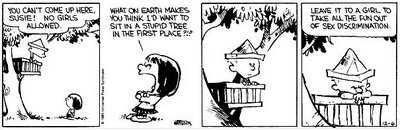
Think I'm the only one who is obsessed with looking at daily comics through the lens of feminist-ish thinking?

One of my favorite blogs does it too, occssionally. Scroll to the end of the post...

Wednesday, January 10, 2007

Preparing for College

I'm back from Christmas heaven and application hell, for the time being, and anxious to get back to blogging-- If only I knew what to blog about.

So, I'll just blog on what I'm already thinking about: College.

Specifically, the fact that that is where I will soon be.

College means new opportunities. I'm not sure which excites me more: the classes I can take or the chance to move out of the house. But there's at least one other crucial opportunity I'll have: a chance to re-invent myself.

You see, although I love my homeschool community, I can't deny that it's a small one. We get about fifty kids, generally, for our biggest dance. That means everyone knows everyone and, usually, has known them for years.

College will be my first chance in a long time to be judged by my behavior, not my history. So I've been inspired to try for some self-improvement before I go. College will also be my first prolonged immersion in anything resembling mainstream culture, and the first social circle I'll enter as an identified feminist.

Since I'm lacking in insight today, I'm going use my signature cop-out, and poll the audience: do any of you readers out there have advice for a young man going off to school? I'm looking primarily for advice relating to gender and/or politics, but practical pointers wouldn't be unhelpful either.

Tuesday, January 09, 2007

Three Short Descriptions of Gender

Something light to get me back into the swing of serious blogging: I was tasked to write a half-page on the following question:

According to [Hilde] Lindemann and other feminist philosophers, "gender" is not just a case of biological characteristics. Briefly explain three other factors related to "gender"


Gender establishes an identity we can claim as our own to guide our interactions with others and with society. It establishes certain norms that we can try to live up to in order to fill our niche: certain descriptors such as “wears frilly clothes” or “has calloused hands” we can take to sketch out an identity.

Gender gives us a way of classifying others. If we accept that gender parallels sex exactly, and that sex is easily identifiable, we can assume a wide range of characteristics for someone as soon as we meet them. Whether they actually possess any of the qualities we ascribe them is secondary: gender gives us a framework for knowing things about people.

Gender provides socially defined and acceptable ways of interacting. If we accept gender as a useful thing it is possible to interact, even with strangers, in complex and socially useful1 ways by following the scripts and guidelines gender lays out for us.

So how would you characterize gender? How would you describe, in a couple of sentences, what it is and what it does?


cross-posted to my blog.

1 Thanks to Jake for the phrase "socially useful".

Monday, January 08, 2007

Gender Identity in Comics

At the risk of this quickly becoming a one-note blog, here's another piece of gender identify problems in comic strips:

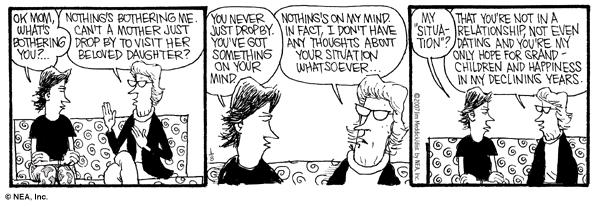
This strip is named "Monty" (formerly it was Robotman, which was quite a bit funnier, really), and the characters pictured have appeared so infrequently that I don't even know either of the women's names. I think this is telling--I know that men are sometimes pressured by family to have kids (from my own experience, in part), but I'm guessing that my intuition that it's more likely to get such pressure if one is a woman isn't far off base. Thing is, this particular strip might actually be slightly funny if it were Monty's mom pressuring him, because he's the sad sack of the strip, the guy who doesn't generally get what he wants exactly how he wants it. As it stands, this strip depicts a sideline character in a run-of-the-mill 'joke' about how mothers of adult daughters just want their kid to have kids (bringing in some ageism to boot!). So, on one hand this strip might just give us a reflection of the way things 'are', but on the other hand it simply isn't very freakin' funny on any level. Whereas Monty as Ladybugman, which I can't find an image of, while still reeling with some gender problems, is at least smirk-worthy.

Friday, January 05, 2007

Where Are All of the (Datable) Feminist Men?

There's a neat little post over at Postcards From Guyville about where/how to meet feminist/feminist friendly men to date. Y'all should go check it out and add to the discussion!

(Postcards from Guyville is just a great little blog anyway, so go check it out.)

Tuesday, January 02, 2007

Gender Identity in the Comics

First of all: Happy New Year everybody! It would be great to have some sort of positive, happy post at the beginning of the year, but the closest I can come to that is to point out some gender reinforcement going on right in the ol' comic strip page. I tend to have trouble not seeing comics through the lens of gender studies and feminist theory--such is what happens once you begin taking in some feminist ideas.

I think comic strips are an interesting place to see how gender is reinforced in our daily lives, and how that reinforcement often affects us all negatively.

DUCK!


Our first comic is Pearls Before Swine. This is a snarky little comic strip, and the artist/author often employs a kind of 'meta' cartoon style, where he draws himself drawing the strip. He also talks a lot about the way strips work from within the strips; recently he introduced a duck character which is a 'nonanthropomorphic' duck to go along with the very antrhopomorphic duck already in the strip. This is an interesting little thing to do, and it's one of the reasons I read the strip. Unfortunately, it looks like he introduced this character as the perfect girlfriend for the anthropomorphic duck: She can't talk like he can, so she can't do all of the traditional things that women do--nag. Except that she can, with one word: "Quack." Not only do we have silly gender assignments such as 'men take out the garbage and watch football', but we additionally have 'women nag'. Even nonanthropomorphic duck-women.

Brrr

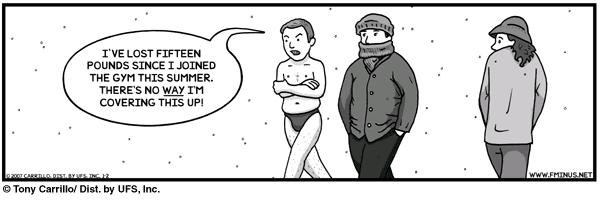
Next up is another of my favorite strips, F-Minus. This is usually a one-panel strip which owes its roots to comics like The Far Side and Bizzaro, but is usually more dry and less full of goofiness than those two. I like this comic in part because one is struck almost immediately (or at least I was) with some suprise that the main character is a man and not a woman. I think this also reflects, however, the degree to which our culture is more and more encouraging men to be body-conscious (in the negative sense) in the way that it has encouraged women to be for a long, long time. But part of what makes this comic funny, if it is funny, is the guy in his speedo freezing his butt off--it if were a woman, we might feel slightly differently, as if that's not a far cry from the truth in a culture full of breast augmentation and butt-firming creams. It's funnier with a man there in part because we don't as much expect men to (traditionally) behave this way.

Mountains and Molehills
Some might say I'm trivializing gender stuff by focusing on a small segment of pop culture--comic strips. But again, these are solid parts of our day-to-day lives (ok, of my day to day life, and I think this is where a lot of the work on recognizing gender norms and how they might negatively affect us can be done.

Wednesday, December 27, 2006

Prime of Life

I recently started rereading Simone de Beauvoir's Prime of Life, one of her series of autobiographical works. It's thoroughally enjoyable, and though it mostly reads more like a travel biography, her existentialism and feminist philosophy are infused throughout. It's wonderful to hear her talk about Sartre travelling with her almost as an afterthought, because here was a woman who simply loved to travel the world because it was a big part of learning.

It's also a rewarding book for those of us who are approaching 40 and beyond, I think, because Beauvoir used her feminism and her existentialism in the way she saw what growing older is like--the ways in which feminism informs how our roles tend to change (as well as cement themselves) as we grow older and the way in which existentialism can help one appreciate life more as one approaches death. We always choose--that's sort of the existentialist motto, and we're constantly choosing our gender roles as well, even (and especially?) as we grow older.

Beauvoir is a huge influence on my feminist thinking, though strangely not so much directly for The Second Sex. Mostly I think her view of existentialism encourages feminist thought, and not only in the ways that The Second Sex proposes (For me, the Second Sex mainly points out that one is made, not born a woman (or man!).) Her view of existentialism, as somewhat opposed to Sartre's, is that our connectivity to others is fundamental. Whereas philosophers since Descartes have proposed "I think therefore I am," Beauvoir (I'm paraphrasing, of course, and oversimplifying) says something along the lines of "I think, therefore we are." We are fundamentally connected to others existentially; we have language, we are social. And we make choices constantly which inform the choices of others and are at the same time informed by the choices of others. Yes, existence and what it means is ours to choose--we can't avoid that, under her existentialism--but that doesn't mean that the choices are wholly ours to choose. We don't choose in a vacuum; rather, we choose in a social context, among others, influenced (but not caused!) by others, and all the while influencing others along the way.

It seems to me that lots of what feminism can be sprouts from this sort of thinking: the ethics of care, antifoundationalism, theories of social knowledge, and even (though Beauvoir would argue against this) some flavors of postmodernism.
Just some preliminary thoughts. Perhaps I'll have more on Beauvoir and her life (and how it informs my own feminism) later.

Tuesday, December 26, 2006

Domestic Bliss

A short little post about division of household labor during The Holidays:

This year I spent a lot of time during Xmas with some friends. It strikes me today, the day after, that it was quite a relief to be in a place where the division of labor along gender lines was practically (though not completely) invisible. Everybody did some cooking, everybody did some cleaning, everybody did some taking care of the little kid.

In the past, with Xmas with The Family, there is always an uncomfortable amount of men sitting around doing little while women (and me, usually) went around doing little cleaning up tasks (though I'll have to admit that my stepdad, who loves to cook, also is very good about cleaning as he goes), or doing the dishes at the end of the meal.

This isn't an intricate examination of division of labor along gender lines--rather, it's an expression of happy-stuff when I realize that I wasn't reminded of this division incessantly this holiday, which is a relief.

Monday, December 11, 2006

Sexism (and Classism) related to - Male Violence

Violence in the United States (at least) includes commonly:

1.) Male vs. Male Violence - gang violence as well as much fighting among men that doesn't involve gangs,

2.) Suicide - particularly in high school age children involving both males and females

3.) Threatened killings of multiple individuals in high schools - such as the Columbine Tragedy

4.) Child Abuse which involves both men and women

5.) Rape and sexual abuse - most commonly Males against Females

6.) Domestic Violence - most commonly Males against Females

A. Male vs. Male violence often seems to get less attention than it otherwise might warrant. This seems to me to relate to the fact that Poorer Men are disproportionately affected by it. It is pretty rare for gang problems to relate to Middle-Class White Boys! Class issues seem most important here.

B. Suicide issues particularly in high schools are getting increasing attention because it seems to be a middle class issue which affects our children who are seemingly "normal". Class seems important here. I'd guess that more girls than boys are visibly affected, but it's not a Gender issue generally.

C. Threatened Killings in high schools is a scary and interesting issue. It is nearly always White Males directing violence at others. Often the others are more teenage Girls. The media do not focus on the "White Male" angle of things and rarely focus much on where Sexism is clearly predominant here. Sexism is clearly an issue here. Failing to look at the "White Male" part of this seems to relate to both Classism and Sexism.

D. Child Abuse issues involve both women and men. Women are the more common abusers however men probably commit more abuse in proportion to how much they do in the raising of children. This is a difficult issue to discuss in a few words.

E. Rape (Sexual Abuse) and Domestic violence are issues where Sexism seems very, very, very important. Classism seems much less important as an issue here. Wealthy women are victims of domestic violence and White Men with Power - are certainly common as abusers in a way that they'd be much less likely aggressors in Male on Male violence. Rape and Sexual abuse most commonly are acquaintances, not strangers who may be upper-middle class people.

I try to imagine such issues reversed - where Middle Class (and Working Class) Men were in need of shelters and other support services in huge numbers because of violence directed at them predominantly by Women.

Where Men - were the Victims - we'd most likely have an "epidemic" which needed an end to it. It would be "fought" and become a rare problem, because as a society we couldn't afford the losses it causes.

I think that we have a similar denial in the U.S. on the psychological effects of War - and the current War in particular - on our soldiers (both Male and Female). In the latter case we have political issues invading the picture complicating things. People might question war more if they knew the true costs it has on us. Perhaps in this case - we also have the flip side of Sexism - where the feelings of Men (there are more Male soldiers than Female soldiers) in particular are minimized.

To me Sexism and Sexism Only - allows domestic violence and rape and other sexual abuse to continue to terrorize and otherwise affect in deep ways the lives of so many (mostly) women year after year, decade after decade. We say that such violence is: "wrong", yet our actions to eradicate it do not make a dent in it in ways similar to how cigarette smoking has been dealt with as a "health epidemic".

Male on Male Sexual Violence particularly in prisons is also an important issue. Its effects are minimized perhaps in part because poorer and more marginalized men are disproportionately affected by it.

Such violence and the threat of it is an epidemic. It gets in the news and then disappears. The womens' lives go on being seriously hurt.

We may take about how Women are now earning more and more in relation to Men and similar. We are lagging in the areas of violence however.

Thanks!

Wednesday, November 29, 2006

New Male Pill

Years ago a partner of mine suggested that if I were as serious about not having children as I say I am (I am), and if I were as serious about feminism as I say I am (I am), then I would go ahead and get a vascectomy. I looked into it, and found that the expense at the time was more than I could afford, being without health insurance. And yet, years later, when my health insurance would cover at least part of that operation, I hesitate. Why? Likely in part because I'm acting from a place of (perceived?) male privelege. That is: I can't get pregnant.

It's more complex than that, of course, but she had a point, really. I can, of course, always wear a condom, but when in a closed relationship of some sort, both partners might not want that if there are other options. Up until now, as far as what men can do, condoms and/or vascectomy were the only options. (This is leaving out the fact that not all sex is penis-in-vagina intercourse, which is an important fact.)

It's looking more and more like men will have more options soon regarding contraception, and I just don't see how that can be a bad thing, at the outset. The newest news I've read (be sure to check out the article, if only to see the cheesy stud-taking-a-pill picture) is that there may be the possibility of a new pill which keeps a man from ejaculating, and may even be taken just hours before sex, with the effects wearing off in a way that a hormonal-based pill can't. It's interesting to me that the article at least touches on conceptions gender-based inequality when it comes to contraception:
Experts believe it could transform family planning by allowing couples to share the responsibility for contraception - a role that traditionally falls to women.

The new contraceptive is likely to appeal to women who are uneasy about the female Pill's ability to raise the risk of strokes, heart attacks and potentially-fatal blood clots.

I like the way the article puts this, actually, because it points to the fact that, in the near future, the impetus for contraception may in fact be 'more' on the man than on the woman--perhaps not as regards consequnces, but as regards who ought to be taking the pill; if men have a simple, non-hormonal based option, then it seems like the responsibility will more fall upon them, given various potential health problems regarding the sorts of contraception choices women have.

And, all-in-all, it seems to me that, when it comes to contraception, more choices is always going to be good.

(This discussion also leaves to the side the fact that it has seemed more important to come up with a safe, easy, 'comfortable' male pill than it has been to come up with something similar for women; it may be that biology may limit these possibilities somewhat, but it's likely that sexism has played a role there too.)

(Hat tip to Feministing)

[[Update]]
Looks like Dave's intuitions were spot on, at least according to one article which quotes various doctors as being pessimistic about men wanting to use such a method of birth control:
"Whatever medication this is going to be, it's not going to influence the sperm," notes McGuire, citing the reported lack of hormones. "It's going to influence the ability of the sperm to get into the prostate to be released during ejaculation - and dry ejaculate is not preferable."

"Not a great idea," agrees Fisch. "The ejaculate coming forward is a significant part of a man's sexuality.


Although, I, too, wonder exactly how the pill may work--and, to get graphic, exactly what it would be like to orgasm without ejaculating--talk about 'the ejaculate coming forward is a significant part of a man's sexuality' cracks me up, and strikes me as one person's opinion that may not jive with the larger male population.

Tuesday, November 28, 2006

Relational Autonomy

False Dichotomies
Among the good discussions that we've had here (in my opinion, of course) at FA have included some interesting takes on what it means to be an individual chooser in a world full of other individual choosers, and how gender and gender inequality intersects with the concept of agency. In a discussion about what men might want to do in order to help create safer-feeling spaces for women (and others) in the world, it was remarked more than once that whomever is feeling unsafe, it is that person's choice to feel that way, or that person's choice to walk down a particular street, or that person's choice to walk down the street any way he wants, regardless of how that might or might not make others feel. Further, for some, the mere suggestion that we are not completely autonomous, rational agents seemed to imply some sort of slippery-slope argument where nobody is then responsible for anything. Eric, for instance, said:
To say that our social circumstances affect our choices to such a huge extent that we are not REALLY individual rational agents, but people limited by our social contexts that the choices are made for us, is to imply that there really isn't such a thing as choice to begin with.

I tried to point out that there was a false dichotomy at work here, between the idea that we are autonomous, atomistic rational agents and the idea that we are mere autonoma, compeltely created by our environment with only 'external' input and no input, so to speak, from the individual. But it can be a tough idea to get one's head around--if the choices we make are affected by our environment, indeed, if the very individuals that we have become isn't simply a matter of individual choice, then what happens to the notions of rights, to the notions of individual autonomy, to choice?

Feminism and the Ahistorical Self
arielladrake, another commentor, points us the way, by first also noting that the dichotomy is lame a false one, but also pointing to the way that feminists may conceptualize agency and autonomy:
Because, for most feminist theory, and phenomenological conceptions of the subject, it's not a case of 'individual rational agents' and 'choice doesn't exist' as the only two options. Because the idea of the individual rational agent in philosophy *is* predicated on this idea of an asocial, ahistorical, transcended subject. And, quite frankly, that's bollocks, because it fails to understand the reality of people. It's the people clinging to this that proclaim any criticism of this fundamental modernist flaw must mean that we are all completely determined and have no choices whatsoever.

But while I knew (and agreed with) various feminist conceptualizations of why ahistorical, atomistic selves aren't very good reflections of people in the world, I hadn't run across any theorhetical frameworks provided by feminists which would help to reconceptualize individual choosers, taking into account feminists' various critiques (except, perhaps, some understanding of the ethics of care, which seemed to me to be useful, but narrow in scope) until I ran across the notion of relational autonomy.

How Relational Autonomy Works
Relational autonomy isn't a simple concept, from what I've been able to glean so far, but we can understand it as consisting of two main conceptual arugments: First of all, 'autonomous' agents can only learn to be autonomous agents from within a social setting. Dr. Elizabeth Sperry, in her paper "Foucauldian Power, Relational Autonomy, and Resistance Through Friendship," points this out clearly and succinctly:
Relational autonomy theorists contend that autonomy is fundamentally social in nature. Far from requiring a complete independence from others, autonomy is made possible only thanks to forms of dependence and interaction with others. First, in our society potentially autonomous agents are constructed as such only through extended periods of dependency on others, usually in family settings. Indeed, insufficient or ineffective nurturing during childhood makes more difficult the attainment of autonomy in adulthood. Certainly others must provide food and shelter in order for young children to be able to attain autonomous adulthood. But young children are not merely physically dependent on others; they must be taught language, various behaviors, the rudiments of self-control, the concept of values, the resources of their culture, and the possibility of relations with others. The development of autonomy is thus not possible in the absence of social relations, including relations of dependency.

So, autonomy, if it exists at all, must develop from within social systems of interactions with others.

But that's not the only place that autonomy relies on relationships with others. The second main point of relational autonomy is that autonomy itself relies on interactions with others to provide the necessary 'raw materials' for decision making. As adults, being social is intextricably intertwined with being autonomous. Sperry explains this clearly:
Second, adult autonomy is maintained in relationships with others. It is difficult to imagine a would-be autonomous agent successfully maintaining her sense of self in the absence of all human interaction, not only because the psychological costs of absolute loneliness would be immense, but because an agent continues to work out her sense of self through social interaction. Linda Barclay notes that “our ongoing success as an autonomous agent is affected by our ability to share our ideas, our aspirations, and our beliefs in conversation with others. It is unlikely that any vision or aspiration is sustained in isolation from others.”21 We rely on others for emotional support, for intellectual interchange, and to supply the context in which many of our own projects can be pursued. Autonomous agents have various goals and desires—to publish a book, to maintain a healthy marriage, to invest wisely for retirement, and so on—which require cooperation from others. Additionally, each of us continues to alter our sense of self and our life plan in response to the input and actions of agents around us.

Finally, the self’s own concepts and values are made possible through social organization. This differs from the developmental point that we learn our culture’s language, concepts, values, and available life plans in early childhood socialization; the claim here is that these elements themselves are culturally created and sustained. The very words and meanings we use to reflect on our preferred path of individual self-development are “constituted by social practices,”22 as is the value of reflecting on our own self-development. Social practices are necessary for autonomy in that they produce its raw matter.

As Sperry goes on to explain, it isn't that we are cut off causally from others that can make us autonomous, or some innate quality that we possess, but rather it is the actual reflection on our environments that help to create autonomous beings. So, to go back to our original discussion about men and their possible responsibilities for behavior simply walking down the street in a sexist society, we might frame it this way: The men who do reflect on the fact that they live in a sexist society and make their decisions with that in mind are being more autonomous--not in the sense of being cut off from others causally, but in the sense of creating a self that makes decisions about itself taking into account others who are outside of itself--than the men who pretend that we're atomistic, that each of us is an individual chooser with no (or little) regard to the input that we recieved as we grew up, or the input we constantly recieve now as adults.

And What Does All of this Have to Do with Feminism?
To bring it back to the topic of this groupblog more explicitly, it's important to note that the entire concept of relational autonomy has as its roots the feminist criticism of the self as an ahistorical, causally atomistic sort of thing--which in part leads to a rejection of overly simplistic conceptions of self, free-will, and, as it turns out, autonomy.

[[edited out 'lame' per ariella's suggestion]]

Tuesday, November 21, 2006

Street Signs and Stick Figures


I'm a bit late on this one, but apparently a community within Madrid has voted to replace street signs that currently feature traditionally male-ish, 'blocky' stick figures with some stick figures sporting skirts, ponytails and ribbons. There has already been lots of discussion about this at Feministing, Pandagon and Shakespeare's Sister.

The Stick Figure
It's claimed by some of the commentors that a stick figure is a 'genderless' sort of representation. I think this is one of those ideas that is touted as 'common sense' which doesn't really match up to the way the world is, or our daily experience in that world. First of all, there is the problem of whether we can currently see people, or representations of people, as 'genderless'. This makes me think of the automated computer-voiced announcements for incoming and outgoing trains on the BART train system here in the SF bay area. There are two distinct voices, one that I think most people would categorize as 'male' and the other as 'female'. It's hard to imagine a voice that one didn't put into one of those categories, even in the case of the voice being completely a computer generated sort of thing.

Gender and visual cues can be just as difficult to separate out, I think, though it is much more complex. One commentor says that a stick figure doesn't have a 'male' gender assignment because you don't see a swinging dick there in the picture--as if that were how one would represent a man with a stick figure. There are also women commenting who think that the stick figure isn't male or female--but I wonder how many of them would walk into a bathroom with a stick figure that was skirtless (so to speak). Men, of course, would not often walk into a room marked with a stick-figure-with-skirt...because that's not gender neutral--it indicates a women's restroom. So, I think that those who are advocating that the stick figure is gender neutral are ignoring the day-to-day workings of things.

Which is not to say that the stick figure couldn't be gender neutral. A stick figure could be a gender-neutral sort of signifier, but it doesn't happen to be, given the preponderance of men-as-norm in our conceptual reality.

One can see that it isn't gender neutral when we then try to 'genderize' the 'neutral' stick figure. If it's neutral, how do we show that it is masculine? One suggestion (and something that was done in Germany for a while, apparently) is to put a top hat on it. In a strange way, this would probably work--in what culture do women wear top hats? (Although I suppose it could be confusing in a girls-only bar.) But what else would signify it as 'male'? I think it's telling that it's much easier to 'genderize' the stick figure as female--we can add a ponytail, a skirt, long hair, or even, as one commentor suggested, boobs; that it's easier to provide the stick figure with a more explicit gender in the case of representing women shows that the man-as-norm conceptual reality is a pretty strong sort of thing. We can't as easily dress the stick figure as masculine because masculine is the default, conceptually. At least that's part of the reason why.

Skirts and Ponytails
I also think that this 'simple' act of changing the street signs points to the relative complexity of dealing with deeply-rooted sexism. Given that in our culture stick-figure representations are not gender neutral, but rather represent the male-as-default conception of representations, how do you change things? Well, if it were easy, you'd wave a magic want and have the deeply-rooted sexism go away--then perhaps you could just use some stick figures which would be gender-neutral. But, given the lack of magic wands in the world, you'd want to do practical things that may raise awareness and maybe even change some people's minds. One way to raise awareness of the male-as-default is to change the male-as-default stick figures to not-male-as-default stick figures. But this ain't easy, really. Dressing up the stick-figures reinforces traditional gender stereotypes, to some degree, and when you're trying to (in part) bring awareness that those stereotypes aren't universal traits 'found in nature' (i.e. some men have ponytails and some women don't wear skirts), you've got your job cut out for you.

I wonder if changing a sexist society necessitates doing so in a couple of stages. First, we change the signs to ponytails and skirts, and then we eventually go back to the stick figures, once we change lots of other stuff such that the stick figures are, then neutral?