"The women of Bikini Kill let guitarist Billy Karren be in their feminist punk band, but only if he's willing to just "do some shit." Being a feminist dude is like that. We may ask you to "do some shit" for the band, but you don't get to be Kathleen Hannah."--@heatherurehere


Friday, May 27, 2011

Men Doing Feminist Work: Yolo Akili

It's been a while since I did a post on men doing feminist work, but when I came across Yolo Akili, there was no question that I had to let folks know about him. (As with many of the men in these posts, I'm sure lots of y'all know about Yolo already, and I'm late to the game!) I was given a link to a new blog series he is working on about "queering the cause" regarding work around men's violence against women that, while probably controversial to some folks in a lot of ways, is nuanced and complex. And in a world (and blogosphere) where we don't often enough hear the voices of black, queer people, I hope his ideas get discussed and expanded upon. Please read his whole series, but here is a tidbit:
As a very visible and vocal queer man my very presence has often been disruptive in these spaces. It has been disruptive because, among many other things, the “violence against women” dialogue is intrinsically heterosexist and homophobic, not to mention virulently sexist. Through my work with numerous organizations that fall under this canon “of violence against women” I have been taken aback at how the generational analysis coupled with a “second wave” narrative of power and gender have produced an enviroment that does very little to acknowledge the deeply rooted relationship between heterosexism, homophobia and sexism. It has also been intriguing to me how many of the organizations who cling to this ideological perspective claim to be unaware of or are dissonant from organizations like Incite who have explored the complexities of these challenges in detail
.


There's not a whole lot that Yolo doesn't do. Here's just a little bit from his "about" page:
He is a graduate of Georgia State University, where he earned his B.A in Women’s & African American Studies. He is a licensed 200 level Iyengar Yoga teacher (RYT), with Yoga Alliance having studied and graduated from Yoga of India Yoga School, in Sandy Springs Georgia. He has been awarded the Creative Leadership Award by the Feminist Women’s Health Center , A ZAMI award and the “Unity In Community Award” from Unity in Christ Fellowship Church.

Through his gender & sexuality activism, he has been an organizer with United 4 Safety (LGBTQ Domestic Violence Organization), Spark! Reproductive Justice and the Atlanta Queer Literary Festival. He worked as the Regional training coordinator for Men Stopping Violence where he organized the mentor program, taught men’s education classes (commonly called batterer’s intervention courses) trained and educated organizations and individuals on gender based violence and was the lead architect and designer of “Mercury” An online training for men on gender based violence. Yolo currently manages the operations of Akili inc, providing provocative trainings, education, yoga classes and spiritual consultations to groups and individuals across the world.


Oh, and he's a poet who produced this short documentary around his poem: "Are We the Kind of Boys We Want?"

Monday, May 23, 2011

Beautiful, Strong Essentialism

Recently I ran across a new promotion from the Women's Tennis Association with a goal of increasing the fan base for women's professional tennis: Strong Is Beautiful. The media campaign combines some amazing photography with video spots about overcoming adversity to become world-class athletes. I have no doubt this is a good marketing campaign--the photos are slick and the video spots are interesting and personal, which is something that fans probably enjoy. And yet, the central message seems pretty clear: Yes, these are world-class athletes, but aren't they freakin' hot?. Sure, the pictures are amazing (I'm no art critic, of course), and most of them show the tennis stars playing tennis--but, sadly, they're not pictures of them actually playing tennis in, y'know, a world-class tennis match. Instead, they're pictures of them playing with their hair down (and in their faces), makeup in full force. And the folks in these pictures are all beautiful, no doubt at all--but because these are pictures of them posing as playing tennis, in a way, instead of actually playing tennis, or at least dressed/made up as if they were, they send a different message than Strong Is Beautiful. Instead, they say, "Strong, But Still Beautiful!"

All of that could be a small step in the right direction. There is a stereotyped idea of what a beautiful woman should be, and "strong" isn't the first thing that comes to mind--wouldn't it be cool if we lived in a world where "strong woman" and "beautiful woman" were more intertwined conceptually? And yet: Why the emphasis on beauty at all?

One answer is that change takes time, and we all have to live in this world the way it is, now--and this is the line of reasoning that Hugo Schwyzer and the folks over at Healthy Is the New Skinny take. They are attempting to change attitudes about what a beautiful body is from within a system that is arguably one of the best at telling us lies about what a beautiful body is: The fashion modeling industry. There are lots of people who think this is one way to make some positive change. They may be right. And yet, I can't get rid of the nagging feeling that this sort of stuff reinforces gendered stereotypes even as it is trying to make some change.

Similarly, the anti-rape campaign My Strength is Not for Hurting encourages men to take a closer look at what it means to "be a man" by emphasizing the traditionally masculine facet of strength. And while I applaud any campaign to bring men's responsibility more into the center of any discussions of rape culture, the emphasis on strength is eventually counterproductive: We need to more often acknowledge that strength isn't an essentially masculine attribute, any more than beauty is an essentially feminine one.

Thursday, May 12, 2011

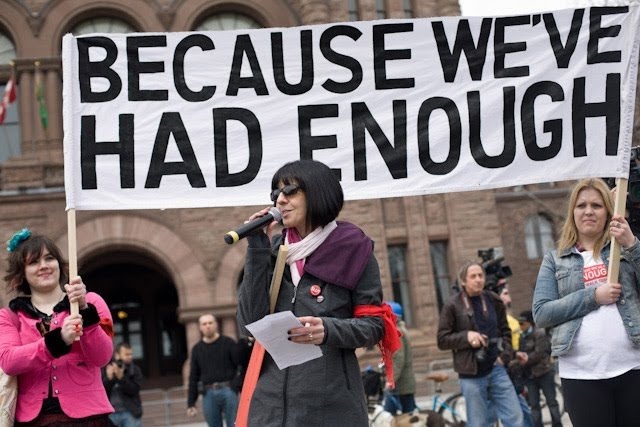
Slutwalk: Disingenuous Debate

I am fascinated by how quickly the activist Slutwalk has taken off. If you're not familiar with it, this is a pretty good summation from the Slutwalk page:
On January 24th, 2011, a representative of the Toronto Police gave shocking insight into the Force’s view of sexual assault by stating: “women should avoid dressing like sluts in order not to be victimized”. As the city’s major protective service, the Toronto Police have perpetuated the myth and stereotype of ‘the slut’, and in doing so have failed us. With sexual assault already a significantly under-reported crime, survivors have now been given even less of a reason to go to the Police, for fear that they could be blamed. Being assaulted isn’t about what you wear; it’s not even about sex; but using a pejorative term to rationalize inexcusable behaviour creates an environment in which it’s okay to blame the victim. Historically, the term ‘slut’ has carried a predominantly negative connotation. Aimed at those who are sexually promiscuous, be it for work or pleasure, it has primarily been women who have suffered under the burden of this label. And whether dished out as a serious indictment of one’s character or merely as a flippant insult, the intent behind the word is always to wound, so we’re taking it back. “Slut” is being re-appropriated. We are tired of being oppressed by slut-shaming; of being judged by our sexuality and feeling unsafe as a result. Being in charge of our sexual lives should not mean that we are opening ourselves to an expectation of violence, regardless if we participate in sex for pleasure or work. No one should equate enjoying sex with attracting sexual assault
.


"Reclaiming" words can be a complex task, and it's no big surprise that some folks disagree with the concept of a slutwalk, including some feminists. Debate about such things is healthy for feminist movements, I think, just as debates in black communities around use of "nigga", and debates in LGBT communities about the word "queer"
can be healthy.

Thing is, much of the debate about slut walk seems to be at the very least misguided, and at its worst completely disingenuous. On the "misguided" end of the spectrum, I really enjoyed Meaghan Murphy's analysis of why Slutwalk stopped appealing to her, but her main take is that it's just not feminist enough, in the way that the "This is what a feminist looks like" video isn't feminist enough (for her), and I simply disagree with her. I don't think that feminism is a zero-sum game where we need to take only one path toward achieving feminist ideals--I think it can be the case that both Slutwalk and Solanas' S.C.U.M Manifesto can provide us all with insights and inspire us to act. I don't have to agree with everything folks on Slutwalk's facebook page say in order to take good things away from it, any more than I have to believe that there should really be a Society for Cutting Up Men in order to take Solanas' views on pornography seriously. Just as a for-instance.

Meagan Murphy is making a thoughtful critique on what Slutwalk has become, or might become, versus what she thought it originally might have been aiming at, and I think that can be a fair criticism. I just disagree with her. Compared to her analysis, the analysis by Gail Dines and Wendy Murphy (no relation to Meagan, I think) is pretty obviously disingenuous. In their Guardian article they say:

The organisers claim that celebrating the word "slut", and promoting sluttishness in general, will help women achieve full autonomy over their sexuality.
and
Women need to take to the streets – but not for the right to be called "slut".


However, a simple, cursory read of Slutwalk's website, including what I quoted above, is enough to show that Dines' and Murphy's "critique" is a simple strawperson argument--sure, if Slutwalk were arguing for the right to be called slut, that would not be the kind of activism feminists of any kind could get behind--but of course that's not what they're fighting for at all. There are all kinds of good criticisms of Dines' and Murphy's article around the interwebs (I like Lindsay Beyerstein's take on it, and Hugo does a pretty good job too), so I won't go into it much, but I'm just disappointed that Dines takes something complex and intricate and tries to present it in such a simplistic way. Checking out some pictures from the (original) Toronto Slutwalk, there are signs that say "If I stop dressing like 'a slut' will I be safe from rape? Stop victim-blaming hold the abuser accountable!" If that's not feminist, I don't know what is, really.

In the debate below, Dines takes it even further. First, she reiterates her plainly ridiculous criticism that women can't "reclaim" the word slut, because it was never used in a positive way--as if the folks who reclaim "queer" and "nigger" were trying to get back to a bygone era when those words meant something positive. But then she takes it further and suggests that the organizers of Slutwalk are just trying to promote themselves personally, and are too steeped in academia, instead of in the real world. Which is just woefully ironic. I have no doubt that Dines does some good work with actual women, but checking out her activism site, Stop Porn Culture, I wonder if she was projecting during that debate, as the front page of Stop Porn Culture has an advertisement for both her next speaking engagement (presumably paid, as it should be) and her book. Is Stop Porn Culture about stopping porn culture, or about Gail Dines?

Of course, such criticism is completely unfair--as activists, folks still have to make money to live, and selling books spreads the word and potentially changes the world. There are unavoidable intersections between self-promotion and changing-the-world, and I'm sure Dines understands that--she must, as she doesn't have a problem with lots of self-promoting on Stop Porn Culture. But of course she has a problem with the organizers of Slutwalk both creating something amazing and at the same time, probably, promoting their own work.

The debate is still worth watching, and a fascinating portrait of disingenuousness.

Tuesday, May 03, 2011

Team Shoot Like a Girl: City Fish

Check out this new short documentary, City Fish, which is a finalist in an international documentary challenge that had some special rules: The film making teams have just 5 days to complete an entire documentary. You would never know it from watching the finalists, or from checking out City Fish, a film made by Team Shoot Like a Girl. From the film makers:


Team Shoot Like A Girl is:

Shaleece Haas
Clare Major
Emma Cott
N'Jeri Eaton
Linnea Edmeier

We're five women doc filmmakers who met in graduate school. We do everything - from directing to editing to shooting and recording sound. We love our craft and want to encourage more women to enter the field - especially the technical areas of shooting and location sound.


I'd say that makes their film appropriate for this blog! And it's a great film! Go check it out, and be sure to vote for it--support women film makers who support women film makers!

City Fish

(Full disclosure: One of the film makers is a close friend of mine.)

Thursday, April 28, 2011

"Nyx sold her womb somewhere between Punjai and Faleen, on the edge of the desert.

Drunk, but no longer bleeding, she pushed into a smoky cantina just after dark and ordered a pinch of morphine and a whiskey chaser. She bet all of her money on a boxer named Jaks, and lost it two rounds later when Jaks hit the foor like an antique harem girl."


If the opening lines to Kameron Hurley's new book, God's War don't draw you in, then perhaps you're just not ready for a hard-boiled queer heroine who drives a car powered by bugs.

Years and years ago, Hurley's blog, Brutal Women, was one of the first blogs I read with some regularity. It had explicitly feminist meanderings, but it was also a blog about how Hurley was learning to box, and how that was affecting her life. From time to time, she would write about a book or story she was writing, so when her book came out, I was curious to read it--with a blog like Brutal Women, I expected the book couldn't help but have feminist threads woven through, and I wasn't to be disappointed. It's refreshing to read a book with subtle feminist underpinnings, with a tough heroine that's realistic (even if she exists in a world full of interesting magic). Even more of a wonderful surprise was that there are multifaceted men in this book, and queer folks, and world-building worthy of the complexities of all of those people and more.

But mostly it was just a fun, action-packed romp of a read. And that's quite an achievement. So go buy it, please. And when you do, send me an email (FeministAllies@gmail.com) so I can let Kameron know that the community here at Feminist Allies appreciates her taking the chance on writing some great fiction with feminist underpinnings.

Kameron was kind enough to allow me to interview her, and to ask her about some of the more feminist aspects of the book. Sadly, marketing any fiction book as "feminist" is probably not (yet?) a good idea if you want to sell more books, or at least that's the conventional wisdom. But Kameron bravely agreed to answer some questions about the book and its feminist threads that haven't been asked about in some of the other interviews she's given. Here's a snippet:

Ultimately, I wrote this book to be a fun, mad-cap adventure novel. Sure, it's got lots of interesting stuff in there about race, class, gender, and religion, but it also has bugs and magicians and shapeshifters and people getting their heads chopped off. If you're not having fun with it, what's the point? I wanted to write the kind of adventure novel I wanted to read, and this is definitely it. Hopefully it will be for lots of other folks, too.


Read the full interview below.

But first, some links!
GET THE BOOK
Kameron's Personal Site
The God's War site
Read the first chapter FREE!
Night Shade Books , which took a chance that some other publishers wouldn't. (I'm going to be buying from them a lot now!)

And now, the interview:
Feminist Allies: I started out reading your stuff way back in the early days of your blog, Brutal Women, when all I knew about you was that you were writing about learning how to box. Of course, you were already deep into the writing of God's War by that time. There seem to be intersections between your life/personality and that of Nyx, your protagonist/anti-heroine in God's War. What did you pull from yourself to create Nyx?

Kameron Hurley: This is always a tricky question to ask an author, because it’s sort of a given that every character you create has little bits of your life in them. Generally, you take a situation and twist it, so the emotion from that time you got beat up in high school becomes the emotion behind the story about a raging street battle on some distant planet. It all comes from somewhere.

I was taking boxing lessons when I first started writing this book, and I definitely wanted to incorporate that in some way. That, and the personal sense of physical power I experienced once I felt like I wasn’t going to trip over my feet. When you’re a not-terribly-fem woman who’s about the height and weight of the average guy, you’re not really sure what your body’s good for. Knowing I could hit something and make it fall down made me aware of my own personal strength in a way I hadn’t considered before. I figured that unless I was skinny and therefore attractive, my body wasn’t good for much. Intellectually, you may know this is a load of crap, but until you find out what it is you can do outside of that narrowly prescribed notion of a “real girl” object, it isn’t very tangible.

I’ve noted elsewhere that I also wrote this book the year I was dying, and that affected a lot of what came through. I didn’t realize just how much whiskey drinking was in the book until after the fact. I went through whiskey while writing this book the same way a lot of writers go through coffee, and it shows.

FA: One of the feminist threads in God's War for me is the simple fact that Nyx is not only her own person, but she is the organizer and leader of her team. She not only has a "room of her own", she's stocked that room with guns, whiskey, and good, brutal people who work for her. Not to mention that working for her isn't always the most healthy lifestyle choice. How important was it for you to have a protagonist who is such a leader?

KH: I wanted a protagonist who was her own person, certainly. To achieve that, though, she has had to become rather monstrously detached from people in a way that you generally see being encouraged in men, at least in our society. She struggles a lot with her people disconnect, but that’s just something that’s going to happen when you raise folks to be killers, whether they’re male or female. One of the sad side effects of being a butcher is… well, you’re a butcher. In order to achieve the life she wants, she has had to give up a lot. That said, her physical strength has given her more freedom than other folks in this world might have. If she wasn’t as good at what she does, she’d have been pulped awhile ago. And, again, that’s simply a result of how this world operates. Nice, passive people just aren’t going to last very long.

Before I created these physically and politically powerful women, I had to create a world where that kind of thing was possible from the get-go. Note that killing people doesn’t have to equal power - and I do want to explore a society where power is not synonymous with brutality and exploitation - but this time around I was more interested in writing something that went against the cliché that every woman-run society is going to be full of peaceful, nature-loving hippies who spend all day winding flowers in their hair. Societies built on the exploitation of either sex are not going to be happy places.

FA: Gender and sexuality are weaved pretty intricately throughout God's War. While Nyx doesn't seem to subscribe to identity politics around her sexuality, the fact that she likes to fuck is pretty central to her character, and she fucks folks of various genders without apology. And many of your supporting cast have what some might call complex sexualities, in a kind of queer and/or genderfucking kind of way, which was refreshing. Can you talk about what you wanted to accomplish with those aspects of characters, aside from simple character development, if anything?

KH: One of the flaws I’d see in otherwise well-developed worlds is that there was a big failure of imagination when it came to social mores, family groups, and sexuality. It was all Ray Bradbury’s Martians sitting in their living rooms with the newspaper while wifey made tea and commented on the neighbors. It just didn’t make any sense to have an alien world where everyone acted like idealized white, middle-class Americans circa 1952.

When I developed these countries, I tried to build them from the ground up. If you don’t have a lot of protein animals, well, you’re going to eat a lot of bugs. If you’re fighting a war that women need to produce children to fight and who also produce the arms and support structures to fight it and govern the country, you need to come up with some fascinating technology and alternate family structures. And in a world where women are all around and nobody sees a guy between the ages of 16 and 40 (if ever – most boys grow up on the coast and go straight to the front – “house boys” can be fostered by some folks, and occasionally a woman does choose to raise her brood herself outside the compounds), well, I just don’t buy that all women are going to be sitting around at home all sexually frustrated (though some certainly will). Especially in a world where you don’t have to worry about stuff like STD’s or pregnancy, women are going to find that they have a lot more interest in being sexual.

I’ve actually had some folks annoyed with the “highly sexual” women in the book, which I find funny. Folks don’t realize that when you remove STD’s and pregnancy from the equation (let alone culture stigma!), women, in particular, are going to be far more interested in sex.

There’s some stuff to be said in there about the overall Nasheenian interpretation of their holy book in regards to sex, too, which is obviously not the interpretation of their neighbors (or of some of the more conservative factions in their country).

FA: Is there any way anybody could read the first line of this book and not think it's a feminist novel?

I’ve been surprised at the number of folks who kept reading after that first line, myself…. It really does tell you exactly what type of book you’re getting!

FA: I generally have an aversion to religious stuff in my sci-fi and fantasy--Battlestar Galactica got boring for me exactly when Starbuck became some sort of savior angel, for instance--but you manage to infuse religion throughout God's War in a way that is intriguing without being heavy-handed. If I understand it correctly, there are two factions at war, and both are descended in some way from current day Islam, with some aliens that actually appear to be (perhaps?) Christians from Earth. I know that you've left some of that ambiguous on purpose, but could you tell us a bit about why you chose to create things this way, and what affect the religious threads have had on the women on your world?


KH: As for who the Nasheens and Chenjans originally were or who the aliens are, that’s very much open to interpretation. I will say that this is so far future I don’t think anybody’s ever heard of a place called Earth.

At its core, the religions in the book are loosely based on Abrahamic religions, which are notorious for being rather bloody, misogynist types of religions, if you look at the history books (and the Old Testament itself!). That said, the books themselves sometimes get a far worse reputation than they deserve - some of Jesus’s most fervent followers were women, and Islam gave Middle Eastern women more rights than European women up until the 19th century. But the interpreters of these religious books have picked up a bad reputation for misogyny over the last couple thousand years. That was one reason I picked them to play with. If you look at the evolution of religions, it’s not the holy books themselves that are neccesarily the issue (many were downright progressive for their time) – it’s who’s doing the interpreting, and for what purpose. With Nasheen, I wanted to look at what would happen when women were given an opportunity to interpret their holy book themselves.

“Adultery is bad” is one of the ten commandments, but I don’t see churches out stoning parishioners who cheat on their spouses. When slavery was no longer seen as a moral and humane thing to do, people stopped quoting the Bible passages that supported slavery. We interpret books based on who we are, not who the people who wrote them were. Because let’s face it – the past was a pretty brutal place. And the more misogynist we are, the more we're going to look for things that support that misogyny.

Every religion we make up in any fantasyland is, by definition, going to be based on some kind of belief we currently have or know about, whether it’s an existing one or one we cobbled together from other sources. I think where most stuff goes wrong is when it tries to fully mirror modern-day religions in some other time and place. It feels hackneyed, tacked-on. And that makes it feel like you’re being talking down to, or preached at. The religions on Umayma certainly have roots in the old Abrahamic religions, but at the end of the day, they’ve evolved into something uniquely… Umayman. That’s what made these novels so interesting to write.
And, you know, with the SF element to the whole thing, it just doesn’t make any sense for me to just slap some kind of belief system whole cloth onto any of these people. The Islam and Christianity and Hinduism and Shinto and Judaism practiced today look very little like the same practiced millennia ago. Thousands of years in the future, they may have the same taste and color and feel of the original, perhaps, but they shouldn’t be like holding up a mirror. Religions are about people, first, and when people change, interpretations change. You can’t throw people into space for a few thousand years and expect them to practice Christianity just like some small Southern Baptist parish down in modern-day Mississippi.

Someone actually asked me once why I didn’t just “make up” the religions in the book, which I found a bit mind-boggling. If you think the Nasheenian or Ras Tiegan or Mhorian belief systems are lifted whole cloth from a modern-day religion, you need to learn a lot more about modern-day religions.

Which also brings up another thing: there’s no such thing as a mono-religion here on earth, and assuming there is in future is also annoying. So there’s no “one” Nasheenian, or “one” Chenjan religion. There are various sects, martyrs, false prophets, interpretations, and plenty of believers and non-believers and everything in between. I was always annoyed by books and films that just assumed everyone believed exactly the same thing. That has certainly affected the women in the book as well – it’s given them a lot more choices.

Something folks miss when it comes to Nasheen is that it’s actually a secular-governed country. Things is Chenja and Ras Tieg are a bit different. I don’t know that that fact has much bearing on how women are treated – Tirhan has a national religion and a form of religious law, but men and women are starting to gain some tenuous equality, which is something folks will read about in the next book. Mostly, I think this is because Tirhan is rich, and can afford not to control its citizens as brutally as everywhere else.

When you want to control a people, you start by controlling women. I’d hazard a guess that you can measure just how “free” a place really is by looking at the health and education level of its women. It will tell you a lot about what that society actually values.

FA: Another feminist thread that I loved in the book was the fact that there are all kinds of different men in the book as well. You've got a somewhat traditional patriarchal villain in Raine--he's a tough guy who thinks he knows better than everybody else. But you've also got Nyx's team, which include a big-labrador-type of guy who can literally shift into a dog, and you've got Rhys, who is reserved and, in some ways, weak and broken; while he has his strong aspects and certainly comes through for Nyx a lot, he's not a traditionally "strong" man. It's great to see such complex masculinity portrayed in fiction--was this a conscious choice, or simply a result of strong character building in general?

KH: One of the things that sometimes gets lost in the “all the men are dead” woman-only worlds is… well, the men. Though Nasheen is a matriarchy, it’s actually pretty obsessed with its boys. How to raise them. Protect them. Mourning them. You can’t build any kind of society where you oppress one half of it and then not mention them again. I did work very hard not to make them taken-for-granted accessories like women are in some 30’s pulp science fiction. The women themselves might treat many of the men as if this is so, but it was important to me to show how this society worked for all the folks in it, not just the ones with the political power.

I initially imagined Rhys to be Nyx’s opposite. A believer where she was an atheist, Chenjan to her Nasheenian, compassionate to her indifference. But he evolved into his own person, with his own complex past and reasons for doing things. It was the same with Khos. I knew that there weren’t a lot of men in the book as spear-carriers, and I wanted to show how somebody physically intimidating would negotiate Nasheen. It turns out, he ended up being quite literally a big puppy dog instead, so there weren’t a lot of Khos vs. female enforcers scenes. I think that turned out to be a good thing, because it went against type. “Oh, of course, the big guy is going to be very brutal and violent!” In fact, he is more often simply very confused and unsure of how to be appropriately affectionate.

Steering clear of stereotypes builds better characters, whether they’re male or female. Sometimes you have to watch yourself, though. It’s very easy to start with a stereotype and keep it the whole way through. I go through a LOT of revisions.

FA: I've seen this asked in various ways on various interviews, but I have to ask: How in the hell did you get this thing published? It's got so much in it that is fascinatingly not-traditionally marketable, or at least it would seem so. You say "fuck" a lot in it, and lots of heads are cut off, so it can't skew toward the younger crowd. It's genre-defying in lots of ways, even though in some ways it's a straight-up hard-boiled-ish assassin's story. It's got lots of religious stuff, queer characters, a bad-ass woman protagonist who isn't shaped like a video-game character (physically or psychically!). Just the fact that the novel takes as a given a culture where the women are the boxers would seemingly freak out lots of publishers. Did you just get lucky? Or did sticking to your guns have something to do with it?

(I'm going to buy some other books from Night Shade, your publisher, just to thank 'em.)


KH: The answer, of course, is that it very nearly didn’t get published. For just the reasons you named. The book was rejected quite a lot for being “not very marketable.” Nobody knew what to do with it. Some of that was the genre mixing – it’s a science-fantasy, or fantastical science fiction, and it’s not really steampunk (in fact, the first time we sold this book steampunk hadn’t even had its resurgence yet). And, yeah, it’s feminist. People told me back at Clarion 11 years ago that I’d be lucky to sell anything that was obviously playing around with feminist ideas.
We initially sold the book to a larger publisher, but they cancelled the contract during the economic bust in `08. Mine wasn’t the only one to get the pink slip, but I suspect one of the reasons were that nobody could figure how to market it. With a big publisher, a book that sells 10,000 copies is a disaster. But if you sell 10,000 copies with a small publisher… you’ve got a hit.
Night Shade picked up the book without much reservation. I was a fan of their work before, which was why I was pretty happy we partnered up. They are willing to take risks are slightly weirder books than the mainstream folks do, and they always have great covers. Not only did I get to have a non-white heroine on my cover (good luck with that elsewhere) but she also got to be a not-skinny one (skinny white girls still end up on most covers, and most authors have no say in it).

To be fair, I did go through the editing process with the larger publisher first, and they didn’t bat an eyelash at all the swearing, which I got to keep in. I didn’t delete a single instance of “fuck.”
If Night Shade or someone else didn’t pick it up, the book would likely just be in a drawer right now and I’d be working on my space opera. You can “stick to your guns” all you want in publishing, but at the end of the day, it’s the publishers’ money on the line, and if they don’t think they can make money on it, it doesn’t matter how good, interesting, or crazy your book is.
Just business, and all that.

FA: io9 and Nightshade offered up your book as a free ebook for a few weeks--as a person who worked for 15 years on a book, how does that feel? Does it feel like an investment in future readers (as it surely is)?

KH: To be fair, I didn’t work for 15 years on *this* particular book! I started concepting this one back at the end of graduate school, so, 2004 or so, and did most of the actual writing in 2006/7. So really, only 7 years…. Heh.

Numbers aside, I don’t mind giving away free books at all. It’s considered a marketing expense these days, and it really does pay off. You get a greater awareness of the book, more folks talking about it, and all that. It’s nice to see so many people reading it, and so many others picking up hard copies after getting the free version. Of course, handing out a bunch of free copies also only works if you have a book people are willing to talk about. We’ll see how things turn out.
But for the record, no, I’m not one of those people who thinks that free copies of a book are going to kill future sales. Giving away thousands of copies of something for free is one of the oldest marketing techniques around....


FA: Are there any other feminist threads that I haven't asked about that you'd want to put out there explicitly? The books certainly speaks for itself, but part of the fun of reading a good book, especially in the age of so-called social networking, is deconstructing and enjoy the book on other levels. Anything in particular that you think feminist-identified readers would be interested in?

Ultimately, I wrote this book to be a fun, mad-cap adventure novel. Sure, it's got lots of interesting stuff in there about race, class, gender, and religion, but it also has bugs and magicians and shapeshifters and people getting their heads chopped off. If you're not having fun with it, what's the point? I wanted to write the kind of adventure novel I wanted to read, and this is definitely it. Hopefully it will be for lots of other folks, too.

Tuesday, April 19, 2011

Walk Against Rape

Last year I participated in SF Women Against Rape's annual fundraising and awareness event, Walk Against Rape. It was an amazing experience, walking through blocked off streets in San Francisco with throngs of folks who were all there for the same reasons: To raise money for SFWAR and to raise awareness of rape and rape culture. I ended up writing about it for an online version of the Washington Post, in part because it was so great to feel solidarity with such a diverse group of folks.

I'm not doing the walk this year (next year I'm hoping to get a team together), but there is an awesome feminist guy, Richard Wright, who blogs at Fem.Men.Ist, who is walking again this year; he was the one who inspired me to walk last year, and this is his 4th(!) year walking. Please go support him--even 5 or 10 bucks can get him to his goal. From his pledge page:
This is my 4th year doing the San Francisco Walk Against Rape, and i am thankful for all of the support to this cause so many of you have given. Rape impacts me through the lives of many people i love, so for me, this is an act of love, and one way i can contribute to dismantling patriarchy. Please take the time to give as generously as you can to SFWAR, the bay area's sole community based rape crisis center. Money you give will not only go towards keeping the 24-hour rape crisis hotline up, but also prevention initiatives re: workshops with youth in schools, multilingual services and more. For more information please click: http://www.sfwar.org/programs.html Thanks again! Together we can bring healing, and create a future where rape is not acceptable
.


Give some support for a feminist man who is doing the right thing. And tell him Feminist Allies sent you over there!

Wednesday, April 13, 2011

Positive Male Sexuality

Jill has a great post over at Feministeskewering an article that purports to explain some problems that (straight, cisgendered) American ladies have regarding sex. She first gives a bit of an overview of some of the reasons why women might have some sexual problems (warning: some of this stuff is very, very funny, so please don't drink liquids while reading this on a computer or over your tablet):
Well, let’s see: Dudes who couldn’t find a clitoris with GPS and GoogleMaps? Women who are taught to be self-conscious about their bodies and especially their lady-bits? Dudes who assume that if they put it in they’ve done their part? Women who don’t feel the same sort of entitlement towards sexual enjoyment as men? Men who see sex as something that they “get” rather than as a dynamic and highly variable set of acts between two people? Women who are raised believing that being too sexual is slutty, but that sex is something that they have to do for men, and that sex is centered on male pleasure? The construction of sex as between men and women, and something men do to women, and purely penetrative, and beginning when the dude enters and ending when he ejaculates? The many wonderful but sometimes frustrating complications of the human brain and body?


And, of course, many of these things are related to why sex is problematic for (straight, cisgendered) men as well.

All of which is to say that men need moremoremore inroads for positive male sexuality. Sure, we need to be able to find the clitoris (if we're straight, and we date cisgendered women). Very important. (Is this really still a problem, in general, by the way? That's just ridiculous. I mean, sure, individually, sometimes they can be a little bit tough to pin down, but really you're not trying to pin them down anyway, right? Aaaaanyway.) But we also need different frameworks around sex and male sexuality (some of which Jill alludes to). Not only do we need the basics of here-is-the-clit-don't-be-afraid-of-it and everybody-gets-to-get-off-if-they-want-to, but we need to know that, in general, sexuality can be complex as heck, and that this can be part of the fun of it.

I mean, we need to know not only that orgasms for everybody is a good rule of thumb--we also need to know that sometimes it's fun to not have an orgasm, and to just see your partner getting off (over and over is sometimes nice). Sometimes it's fun to trade off orgasms--you, then me, then you, then me. Sometimes it's fun to play within traditional gender roles, but sometimes it's fun to fuck with them. And to, y'know, fuck with them.

So, I'll throw it out there to all y'all: Where should men go to learn about, recognize and create positive male sexuality? C'mon, help me out here.

Tuesday, April 12, 2011

Cawfee

Scarlet City Coffee

I don't think I've ever encouraged anybody to buy anything through this blog--unless it was to encourage people to buy into some of my ideas. I've not even tried to do advertising here for stuff because I'm just not into branding myself or my ideas so much. And yet, when an opportunity comes along to support a women-owned business, it's hard to resist. So here goes.

I could go on and on about sustainable/organic/blahblahblah. I could talk about the great sci-fi theme behind the business. I could implore you to do your feminist best to support a woman in a business that is (severely) dominated by boys. But really, you should try this coffee, because it's just really, really good. Yum. Roasted locally in Oakland, California. I recommend Doubleplusgood to start off with (named for a term in Orwell's 1984?).

If you don't believe me, how about an honest-to-goodness coffee reviewer? From The Awl Review:
Why is your coffee so insanely delicious? I swear, this is the best coffee I've ever had in my entire life. Like I want to drink it all day and night.

Full disclosure: Jen is a friend of mine. However, I get nothing from promoting her wares here. No deals or free coffee for me. I know, because I asked, like four times. Oh well. I'll just sip my coffee and count my blessings.

Tuesday, March 08, 2011

Female Directors

Lots of us get most of our movie fix from Netflix these days. Guess how many of those movies are directed by women? Around 2%.

So, some folks got together using Netflix's API and produced FemaleDirectors.com, which lets you see the movies Netflix offers which are directed by women.

Check it out!

IWD: 100 Years

All y'all already know it's International Women's Day. Right?

I wish I could write more today. But please check out one of my favorite blogs,http://www.blogger.com/img/blank.gif in the spirit of IWD, which covers all kinds of feminisms, but also sheds all kind of light on feminist activism in various parts of Africa: Black Looks.

Also, check out the IWD site, including all kids of events going on:

Monday, March 07, 2011

Simple Sexism: Looking In

I was talking with a woman who works at a cafe I go to about what we each did over the weekend, and I found out that she was in two bike races! I like talking with her because she really likes exercise, and is one of those people who sort of radiates athleticism. Folks like that can be really encouraging to me, when I meet them in day-to-day life, because they can help reinforce the idea that one doesn’t have to be a full-time athlete to be healthy, or even athletic. Weeks ago she had mentioned a tough yoga class she was taking at the college she goes to, and I asked her how it was going now. She told me that she dropped the class--her friends had dropped out of it, it was at an inconvenient time, and there was another problem: Creepy guys from the gym next door kept walking back and forth next to her classroom, staring through the windows at the women doing yoga.

My heart sank.

It’s such a simple kind of sexism, and yet these men managed to discourage this woman enough to have her opt out of her class. It’s a good guess that most of the men don’t even think twice about staring in at the women doing yoga--or if they do, they imagine that they themselves would really love it if women stared at them while working out, not acknowledging the contextual differences between the two situations. And it my cafe buddy made this decision very matter-of-fact-ly: Too many creepy guys, so she stopped going. This is just the kind of decision she sometimes has to make, as if guys looking in at you while you exercise is just something true about the world that you have to deal with, like taking an umbrella with you when it’s raining.

But that sort of sexism isn’t a given--as men, we can recognize how that might make women feel, and adjust our actions accordingly. We might call other men out on it. We might help create a world where the literal male gaze isn’t just one more hazard to be figured in while walking through the world.

Thursday, March 03, 2011

Sex-Negativity in Porn Criticism

Whenever folks talk or blog about porn, there are always strong reactions (and lots of hits!), often overstated or oversimplified. I noted a long time ago that I agree with Lisa Jervis when she asks: Can't we talk about porn without having the same conversations over and over again? Human sexuality is complex, and our relationship to porn is complex--the conversations we may want to have about porn should necessarily be kinda intricate.

That said, why is it that most porn criticism I read tends to have an undertone of sex negativity? I like criticizing porn--there are so many reasons to do so, and I think it's important to not just take so-called "porn culture" as a given. We should criticize the industry for its sexism, racism and transphobia (of course, such criticisms should also be dealt out for most industries!). We can examine the ways in which porn and easy access to it can, has and will change our sex lives. But I wish that we were having such conversations within a larger conversation about positive sexuality, rather than framing the conversations within mostly heteronormative, not-kink-friendly frameworks.

Take Marina Robinson's article about the ways in which porn viewing may be changing the structures in the brains of young men. There's some interesting stuff in there. In particular, it's interesting to read her take on how the so-called "reward circuitry" of the brain may reinforce sexual habits in a way that we may want to pay close attention to. I'd say that the science still seems "iffy" to me, but it definitely worth lots of more study, and, like I said, it's interesting.

And yet, she has to throw in subtle moralizing that, for me, undermines her persuasiveness. For instance, she says:
"Masturbation based on imagining affectionate contact with a real potential mate is stimulating enough, especially for a teenager. But masturbation based on shocking stimuli, by gradually numbing the brain, can shift the user’s priorities away from real potential mates."


There is a lot of loaded language here, and it seems to me that she must know that the language is loaded--she was a lawyer before going into the porn-criticizing business with her husband, so I imagine she chooses her words very carefully! And yet, she is above saying quite clearly that one's priorities when having sexual fantasies should be on one's "real potential mates".

To which I ask: Why? And who gets to decide that? I mean, if one's sexual fantasy life is larger than one wants it to be, that's one thing--but the idea that, somehow, the goal of fantasizing is to only imagine "affectionate contact with a real potential mate" seems (if you'll pardon me) perverse.

And this betrays her view of masturbation in general, a view which has rung out through the ages: Masturbation is practice for the real thing. And this is a limited (and limiting) viewpoint. Masturbation can be practice, for sure. But it can also be having fun with oneself. Sometimes we may want to simply be alone and jerk off. Of course we might want to take care that we don't over-isolate by doing so, and we will need to navigate our other sexual relationships (if I jack off too much when I'm alone, and don't feel like having sex with a partner, that does mean something). But starting from a place where we only masturbate as practice is limiting ourselves unnecessarily.

And the sex-negativity comes out in other ways. I mean, she argues against the use of "sex toys" (though she doesn't define what a sex toy is--are buttplugs sex toys? are feathers? how about a bed?) as another "overstimulator". These are toys! You play with them! Of course they shouldn't be the only thing you use to get off--unless, of course, that's what you're into.

It's stuff like the above that makes me question whether the science is being made to fit very limited views of sexuality, rather than coming in to explain what's going on.

Monday, February 14, 2011

A Bunch of Men Argue About a Woman's Right to Choose, Part 4,580,800

This is a fascinating piece of video to watch. It's long--I recommend watching it while doing some chores or whatever, but then you won't get anything done, because you'll keep coming back to it. The short version is this: A bunch of men argue about a bill to restrict a woman's right to choose, and the only woman who attempts to speak (at 1:09:15) is first of all repeatedly not recognized to speak, and then is shut down, even in the face of her pointing out that a bunch of men have just been allowed to speak about a law that only affects women.


Hat tip to: Crooks and Liars, although the folks at C&L then also cut off the sole woman congressperson by cutting off the clip just as she begins to speak. Sheesh.

Friday, February 11, 2011

If I Don't Lurve the Good Men Project, Am I Evil?

Recently I wrote about how much I was enjoying The Takeback, and about why I enjoy it more than The Good Men Project. I prefaced that piece by noting how exciting and great it is to have so much good writing around redefining masculinity in positive ways--when I started blogging, this just wasn't so much the case.

Thomas Matlack didn't *quite* appreciate my "faint praise" of his GMP, which is sort of understandable--who loves faint praise? And yet, I think his response to my criticisms deserves a response. Thomas says:
Well as the founder of THE GOOD MEN PROJECT I take this as faint praise as worthy of the cause. I actually think manhood in 2011 is a complex topic that doesn't fall easily into one user fits all definition, of what it means to be good, a good dad, husband, worker, son or man. That's why we promote discussion rather than playing God. If you want to hear what you already believe perhaps that is uncomfortable. But we think its important. Please come join us.

So. Here goes.
@Thomas:

Thanks for stopping by--it's always nice when the A-listers (a published book and a for-profit blog? I say you're an A-lister!) take notice.

I do have to ask: Are the ALL CAPS really necessary? I mean, I already linked to your site a couple of times. Then again, you're making money and I'm not, so what do I know about promotion? :)

I don't appreciate the condescension ("if you want to hear what you already believe perhaps that is uncomfortable"), but such a response does rather reinforce my point that I don't enjoy GMP as much as The Takeback, in part because the GMP isn't explicitly pro-feminist. If you *really* think that my preference for explicitly pro-feminist writing means that I only want to hear what I already believe, then we probably don't have a lot to "converse" about. :)

That said, I've already responded on your site (in some comments) to all y'all's "boilerplate" response to criticism, which amounts to, "Hey, we don't take sides (or, "play God", as you put it--though most people wouldn't count necessary, practical editing of content as playing god) because we want everybody in the conversation."

I had a complaint, which was part of a conversation, on your site. The "conversation" that was being had started with a post that can be summed up as "men shouldn't get married because women are gold-digging bitches and the courts hate men because of feminism" included this super interesting sage advice:
"
Learn from your partner’s behavior. How does she act when you disappoint her? What is her reaction to hearing the word “no,” or when you choose your way instead of her way? If she takes it in stride and moves on, then you might have a keeper. However, if she responds to the fact that you went golfing when she didn’t want you to by cutting you off in the bedroom for a few days, or by telling you how selfish and immature you are for having any interests that don’t revolve around her, what do you imagine she will do when she fully believes that you are responsible for every ill in her life?
"

When some folks (who are, y'know, part of the conversation that you're all wanting to have, right?) criticized the author (I use the term loosely) for not only his bitterness, but also his thinly veiled misogyny, and then criticized all y'all for your editorial decisions around letting this douche post his bile, one of your editors chimed in with your boilerplate editorial response to criticism:

Henry P. Belanger says: Mordicai, would you like our staff determining / defining “good” for everyone? It’s unfortunate that our name can be misleading, but I think you’d agree that a magazine that told everyone how to be good wouldn’t be around very long. Goodness also entails being open, listening to divergent voices, allowing for the possibility that people’s minds can be changed, believing that “once bad” doesn’t mean “always bad,” etc, etc. I can’t tell you how many comments we’ve had in the past 8 months that sarcastically put “good men” in quotes, suggesting that we did not meet their standards for goodness. these commenters have come from all across the political / ideological spectrum. The more it happens, the more confident I am that our approach here — being a wide, open marketplace for ideas — is the good approach to take.


I responded with this:

Your “editorial” position is either not well thought out, disingenuous, or both. Putting forward that you want to encourage conversation doesn’t absolve you of drawing *some* lines. There are men, after all, who believe that “being a good man” includes physically and emotionally dominating women and other men–-presumably you wouldn’t allow a well-written, clear article which centered “being a good man” on how to beat the crap out of any person who challenges one’s opinion. So, you do draw lines circumscribing the conversation that have nothing to do with how well-written something is. You just don’t keep folks like Paul Elam from adding his voice to the conversation. What folks like Mordicai and SaraMC are saying (in part) is that this sort of unsupported tripe isn’t just one more opinion among many (as you imply)–rather, it’s unsupported misogynist tripe.

Which is fine. It’s your site. Just don’t expect everybody to pretend along with you that it’s a useful conversation.


Short version: Criticism of your site and/or its authors is part of the conversation.

I'll probably keep reading The GMP (for some reasons I'll give below). So, in effect, I already have joined your conversation. But I'll likely keep complaining that you're giving voice to opinions that aren't "complex"--they're sometimes misogynistic. And you'll continue to get called out on that for as long as people who read your site care about women (and men, and folks of all genders). Saying "it's all a conversation" doesn't get you off the hook for criticism of the editorial choices you are making.

Having said all of that, there are some things I like about the GMP, in the way that I will read BUST magazine, but prefer Bitch magazine, if I can get it--you're writing to men about alternative masculinities, even if I'm of the opinion that at least some of those masculinities aren't alternative at all, but rather more of the same (e.g. MRAs who love privilege and making more money than women but hate alimony). I mean, right now you've got a great post by a transguy. It will be a long time before traditional men's magazines have such an article, I'd guess. So, yay, I welcome the GMP. That doesn't mean I have to always loooooove it.

Thursday, February 10, 2011

Shall I STFU?

Or:
It's All About Me, Right?

Sometimes, I don't do well with people who are in positions of authority. It may be the case that I have a neurotic problem with authority--in part because I grew up watching my mother struggle with sexism in her workplace, with her husband, and in the larger world. I think that having "problems with authority" may be a relatively healthy reaction to an unhealthy society, where it is often the case that those in power are harming those with less power. What is an appropriate response to oppression, other than a desire to fight back? (Of course, this is oversimplifying--other responses include caretaking of self and others, compassion and empathy. But I think a desire to fight should be in there too.)

And yet, there is another aspect of my resistance-to-authority, and it is rooted in patriarchy. Men are taught The Hierarchy, and are shown over and over again, that they have a place in it--above some men, below others, above all women, etc. And generally, we are told, we should be striving to be as high up on that ladder as we can be. This is putting it very starkly, of course, but this is essentially a big part of what men are taught. So, I resist authority in part because, on some levels, I want to be higher up on that ladder of hierarchy than the men (and women, and folks of all genders) who are currently above me.

Given these two factors, and many others, my instant reaction to having bullshit called on me, and/or being told to shut the fuck up, is that my hackles go up, and all of my defenses come to the fore. (Of course, having the safety and space to be defensive, may be a reflection/product of my own privilege.) So I am sometimes left in the following position, when somebody is attempting to call me on what they see as my own bullshit: I have to decide--Are they right, in which case I need to stand down and apologize? Or are they being bullies, in which case I need to step up and perhaps take them down a notch?

And sometimes the question is very easy to answer: If I use the word "lame" and get called out for ableist language, it's pretty clear that I need to apologize and take a step back to examine my privilege in that regard. (For some reason, "lame" has been a hard habit to break for me.) If an MRA guy tries to call me out for not including his woes around child support in a post about how women make less, on average, than men, I can be pretty assured that he's a douche and a bully, and is trying to impose his opinion in a way that isn't helpful (in part because of the aforementioned privilege that makes him think he needs to/deserves to move up the ladder with every interaction). And of course, somebody can (correctly) call me on my bullshit and also be cruel and rude about it: But that doesn't make them a bully in the sense that I'm talking about. It matters who is holding privilege--women feminists being cruel to me can cause me some pain, but they (generally) aren't using their privilege to do so. Which, y'know, matters.


Sometimes, though, it really is hard to tell whether I am responding to a sincere bullshit-call-out or a bully. And in these cases, I tend to err on the side of re-examining my own privilege, because, really, who couldn't stand to do that some more? Also: I don't have to stand up to every bully myself--I am part of various communities that do social justice work, and there are lots of people ready to stand up to bullies in those communities. And this is also a situation that will always recur: Given that I live in a patriarchal society, and given that I engage with both activists and folks in the larger world, I will sometimes screw up and get called on my own bullshit, and I will sometimes run into bullies who need to be stood up to. It just will happen.

All of which is to say that I have myriad reactions when I read Twisty's words at I Blame the Patriarchy:
But really, it’s comical, the predictability with which dudes who fancy themselves feministically enlightened just can’t seem to shut the fuck up when they are found to be duding the joint up a little too hardcore.

My first reaction is that my hackles go up. (Ok, my *first* reaction is to chuckle at "duding the joint up," because that's great use of language.) But then I reflect on where that feeling I'm having is coming from (privilege!), and where the criticism is coming from (Twisty, who knows her stuff, generally)--and I have to let it go. And it's not that I can say, "Well, she's not talking about me." She *is* talking about me, and men like me, when we screw up and can't see our privilege getting in the way of our thinking and talking. It does happen, even to those of us who are trying to not let that happen. I do my best, and I will sometimes get it wrong. Nobody likes to think of themselves like a douchebag, but all of us find ourselves saying stupid stuff sometimes, getting things wrong sometimes. So, sometimes, if I'm told to STFU, it's good to do just that.

Wednesday, February 09, 2011

Enjoying The Takeback

Or:
Why I'm Enjoying The Takeback more than The Good Men Project

Is it just me, or is there a cacaphony of intelligent, thoughtful writing right now that centers around redefining masculinity in ways that reflect at least some of the progress that has been made by feminism against patriarchy? Most recently, I've started reading both The Takeback and The Good Men Project.

Originally, I thought I'd write a long post comparing and contrasting these two sites, but upon further reflection, that seems like a lot of work, and there's no real reason to do that. The two groups of men are coming from different places, have different goals, and will therefore produce different content. And, though there are interesting articles in both places, The Takeback is explicitly pro-feminist, while The Good Men Project embraces the idea that they are allowing "both sides" to have a conversation (as if feminism, with its long history, is on one side while MRA's, who are comprised mostly of men who love the status quo of patriarchy except where it means they don't get laid and/or get custody of their kids sometimes, are on the other side).

Which is not to say that The Takeback is free from controversy, or that I like everything they're writing about; rather, it's more clear that the men (and women, and folks of all genders) who are putting The Takeback together are obviously more aware of the work that has already be done by feminists, and want to build on that. The Good Men Project is more obviously a profit-motivated sort of enterprise, with aspirations of a media empire--and as such, they cater more toward the mainstream.

It reminds me a little bit of what I perceive as the difference between Bitch magazine and BUST magazine--Bitch appeals much more to me, in that they take a more feminist stand on lots of things (for instance, they don't accept tobacco ads, in part because it's a feminist issue), but I can totally see why folks might want to read BUST, because it is something of an alternative to traditional women's magazines. At any rate, I think it's good that The Takeback and The Good Men Project are both out there, though I'll turn to The Takeback more often for more interesting conversations.

And I have to face it: The Takeback is the sort of thing I had envisioned Feminist Allies becoming someday--only it's way more slick, interesting and inclusive than I could ever have made this site, probably. But I'll happily read them, quote them and link to them!

Wednesday, January 26, 2011

Men Doing Feminist Work: Poetry Edition!

I think this is a first for Feminist Allies (which is kind of embarrassing, really): Poetry. Andrew Rihn, a reader of FA, let me in on his chapbook Outside the Clinic. I don't know much about poetry, but I know what I like: A man writing about reproductive rights in wonderful language. My favorite is "PETA weighs in", but I also really like "Midwestern Sex Talk" and "The Life Counselor". This is a man doing some great feminist work.

From the author's note:
As a male, I’ll never have an abortion. One of the privileges of
my sex is that I will never enter an abortion clinic as a patient.
However, according to Dr. Leroy Carhart, a friend and
associate of Dr. Tiller’s, “men have had unlimited availability to
‘abortion’ since the beginning of time. Men can walk away from
unwanted pregnancies with virtually no response from
government.”

While our current political discourse typically rests on binaries
(good and evil; them and us), poetry often resists such
discourse. Its lines are less clean cut, less distinct. It
encourages us to see people as complicated human beings, not
simple rhetorical subjects.


And a review:
“The American debate about abortion and contraception is too often
conducted with anger and violence. Outside the Clinic is a powerful
look at these issues and those who stand on either side. It reveals
everyday truths that are often drowned out by the politicization of
abortion. It looks beyond the commotion and into the heart.”
—Kellie Copeland, Executive Director of NARAL Pro-Choice Ohio


Buy the chapbook here.
Read it online here.
Check out Andrew's blog: Midwestern Sex Talk

Tuesday, December 21, 2010

Wolf vs. Friedman

Naomi Wolf vs. Jaclyn Friedman: Feminists Debate the Sexual Allegations Against Julian Assange
(Note: You have to sit through 2 minutes of pledge drive before the 10 minute video begins...)


Shorter Naomi Wolf: It's not rape if you don't repeatedly say no, even if you're being threatened and held down.

Shorter Naomi Wolf: It's not rape if he starts putting his cock in you while you're asleep.*

It's much more apparent to me now why Friedman and Valenti named their book Yes Means Yes. If somebody like Wolf who has worked with survivors for so many years can get consent so wrong, I just don't know how we're going to shift cultural norms around rape. Perhaps if Wolf had spent less time during the interview expressing how offended she is, while providing a litany of experience, her "arguments" would be more clear to me...

*of course, if such a scenario is talked about ahead of time, and asked for with an enthusiastic "yes!", that's different.

Friday, December 17, 2010